
Exoplanets: The Search for Distant Worlds

Exoplanets, or planets around other stars, have fascinated scientists and the public. They show a wide range of worlds, from very hot Jupiters to Earth-like planets. Each new find helps us learn more about how planets form and if life exists elsewhere.
The search for these distant planets has led to big steps in science. Astronomers keep finding new ways to see these worlds. They’ve discovered many planetary systems that surprise us and make us rethink the universe.
The hunt for Earth-like planets is getting more exciting. It makes us dream of finding worlds that could support life. This journey into space is making us curious about our galaxy and how planets form.
Exploring the Cosmic Neighborhood
Barnard’s Star: A Celestial Gem Harboring Exoplanets
Astronomers are fascinated by Barnard’s Star, our closest neighbor at 6 light-years away. This red dwarf star moves quickly across the sky. It has an exoplanet called Barnard b, which is half as massive as Venus.
Barnard b orbits its star in just over 3 Earth days. It’s very close, only 1.8 million miles away. This is just 5% of the Sun to Mercury distance.
The surface of Barnard b is extremely hot, reaching 257°F. This makes us think there might be more planets like Earth around Barnard’s Star. The discovery of Barnard b shows there are many small planets in our area of the universe.
Recently, we’ve found planets like Proxima b and d. The Extremely Large Telescope (ELT) will help us learn more about these planets. It will change how we see planets beyond our solar system.
| Exoplanet Discovered | Barnard b |
|---|---|
| Host Star | Barnard’s Star |
| Distance from Earth | 6 light-years |
| Mass | Half the mass of Venus |
| Orbital Period | 3.15 Earth days |
| Orbital Distance | 1.8 million miles |
| Surface Temperature | 257°F |
Jonay González Hernández led a 5-year study to find Barnard b. His team’s work was published in Astronomy and Astrophysics. This discovery shows how diverse planetary systems can be. It also excites us for the chance to explore more habitable worlds.
The Dance of Celestial Triplets
Astronomers have found a unique triple-star system in space. It shows how stars move in harmony. A pair of stars orbit each other in under two days. Meanwhile, a third star circles them in just 25 days.
This system is the fastest known triple-star system. It beats the old record by over 8 days. The discovery is thanks to a team effort between pros and amateur astronomers.
They used data from NASA’s Transiting Exoplanet Survey Satellite (TESS) mission. This shows how citizen science helps us learn more about space.
| Characteristic | Value |
|---|---|
| Number of stars in the system | 3 |
| Orbital period of the inner binary | Less than 2 days |
| Orbital period of the third star | 25 days |
| Previous record-holder orbital period | Over 33 days |
| Discovery method | NASA TESS mission and citizen science collaboration |
This dance of stars is not just fascinating. It also helps us learn about triple star systems and eclipsing stars. By studying these stars, we gain insights into the universe’s diversity and complexity.
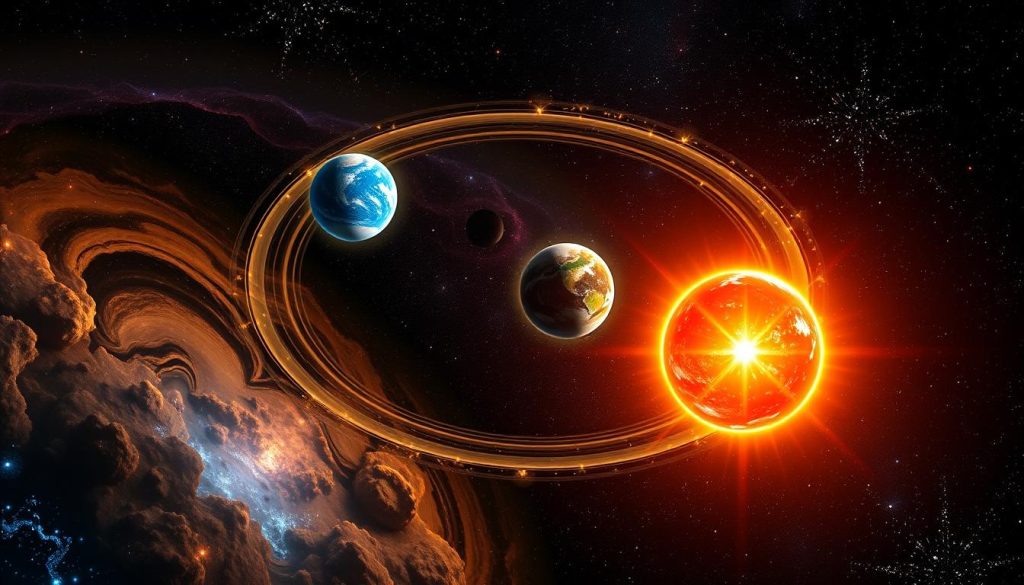
Exoplanets: Unveiling Alien Worlds
From Hot Jupiters to Earth-like Planets
The search for exoplanets has shown us a wide range of alien worlds. We see everything from the very hot hot Jupiters to planets that could be like Earth-like planets. Scientists use different planetary detection methods to find these planets. They look for planets by how they pass in front of their stars and by how stars move.
NASA has found 126 new exoplanets. A team looked at over 13,000 measurements to find the masses of 120 planets and 6 possible planets. For example, the TOI-1798 system has two planets, one orbits in 26 days and the other in 227 days. Another planet, TOI-1386 b, is like a “sub-Saturn” and orbits its star in just 26 days.
Some planets are even more extreme. One planet’s year is less than half a day on Earth. The planet TOI-1798 c gets over 3,000 times more sun radiation than Earth. This heat is so strong it likely took away any atmosphere it had.
| Exoplanet | Characteristics |
|---|---|
| TOI-1798 c | Receives over 3,000 times the radiation of Earth, likely lost any initial atmosphere |
| TOI-1386 b | A “sub-Saturn” planet that orbits its star in just 26 days |
| Planet in the catalog | Has an orbit so short that one year on it lasts less than half a day on Earth |
Every new exoplanet we find helps us learn more about how planets form. With over 5,600 exoplanets found so far, we’re getting closer to understanding life beyond our solar system.
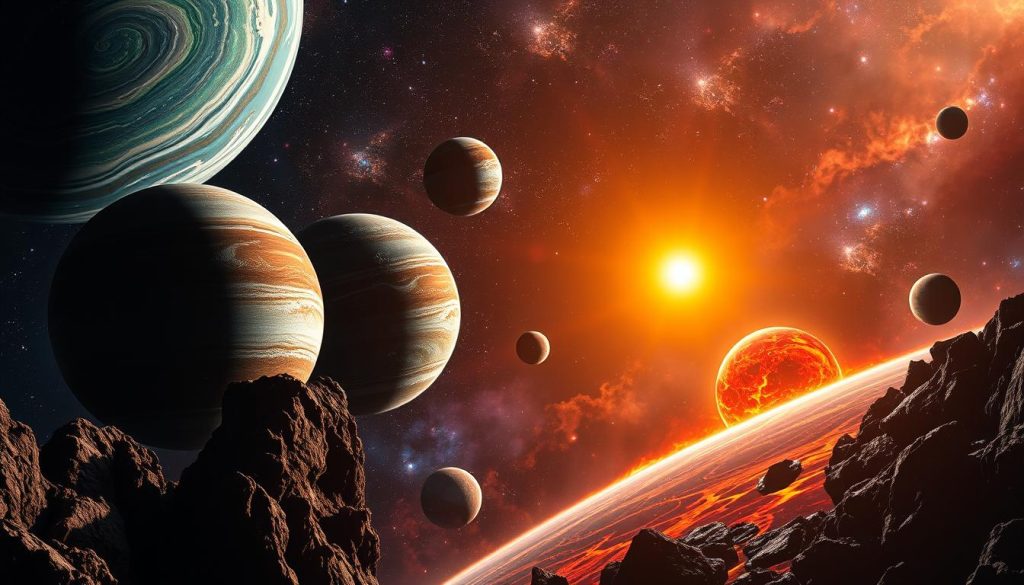
Barnard b: A Scorching Exoplanet Discovery
Astronomers have found a hot exoplanet called Barnard b. It orbits the nearby red dwarf star Barnard’s Star. This planet is about half as massive as Venus and is just 1.8 million miles from its star.
It orbits its star in less than four Earth days. But, it’s too hot for water to exist on its surface. Temperatures there reach a scorching 257°F (125°C).
Despite the heat, finding Barnard b shows there are many small planets in our area of the universe.
| Characteristic | Value |
|---|---|
| Mass | Less than Earth |
| Orbital Period | 3.15 Earth days |
| Distance from Host Star | 1.8 million miles |
| Surface Temperature | 257°F (125°C) |
| Host Star | Barnard’s Star (M-type red dwarf) |
| Distance from Earth | 6 light-years |
Jonay González Hernández led the team that found Barnard b. They studied Barnard’s Star for five years. They also think they might have found three more planets around the same star.
 Dwarf Planets: Pluto and Beyond
This discovery shows how much we still don’t know about small planets. It also makes us excited for what the Extremely Large Telescope (ELT) will find. The ELT will help us learn more about exoplanets and if they could support life.

Unlocking Planetary Formation Secrets
The discovery of diverse exoplanetary systems has given astronomers key insights into planetary formation. By studying these distant worlds, researchers learn about protoplanetary disks, stellar dynamics, and more. These factors are crucial in shaping planetary systems.
New tools and techniques are revealing the secrets of exoplanets. For example, the James Webb Space Telescope will offer deep insights into exoplanet formation and composition. Its 6.5-meter primary mirror is a game-changer.
Research has shown the wide variety of exoplanetary systems. We’ve found sub-Neptunes, the most common planet type, and even an Earth-sized exoplanet around a small star. These discoveries challenge our old views on planetary formation.

Astronomers are also exploring exoplanetary atmospheres. They’ve found signs of possible atmospheric gases around distant worlds. This helps us understand how planetary atmospheres form and evolve. It could also tell us about the possibility of life on these planets.
The search for exoplanets is rewriting our understanding of planetary systems. Our own system included. The future holds even more exciting discoveries as we uncover the secrets of planetary formation.
The Very Large Telescope: A Window to Distant Realms
The European Southern Observatory’s Very Large Telescope (VLT) is key in finding and studying exoplanets. It uses adaptive optics and spectrographs to spot and study distant worlds. These tools help us learn more about exoplanets, opening doors to new discoveries.
Adaptive Optics and Spectrographs: Precision Tools for Exoplanet Hunting
The VLT’s adaptive optics system fixes the distortion from Earth’s atmosphere. This gives astronomers clear images of far-off objects. The spectrographs then help study the atmosphere of these planets, revealing their size, mass, and more.
- The VLT’s adaptive optics and spectrographs have been key in finding and studying many exoplanets.
- These tools let astronomers look at the atmosphere of distant planets, giving us clues about their habitability.
- The VLT’s work has greatly expanded our understanding of different types of exoplanets, from hot Jupiters to Earth-like ones.
The Very Large Telescope has changed the game in exoplanet research. It lets us see deeper into space and learn about distant planets. With its advanced tools and power, the VLT keeps pushing our knowledge forward, leading to more discoveries about life beyond Earth.
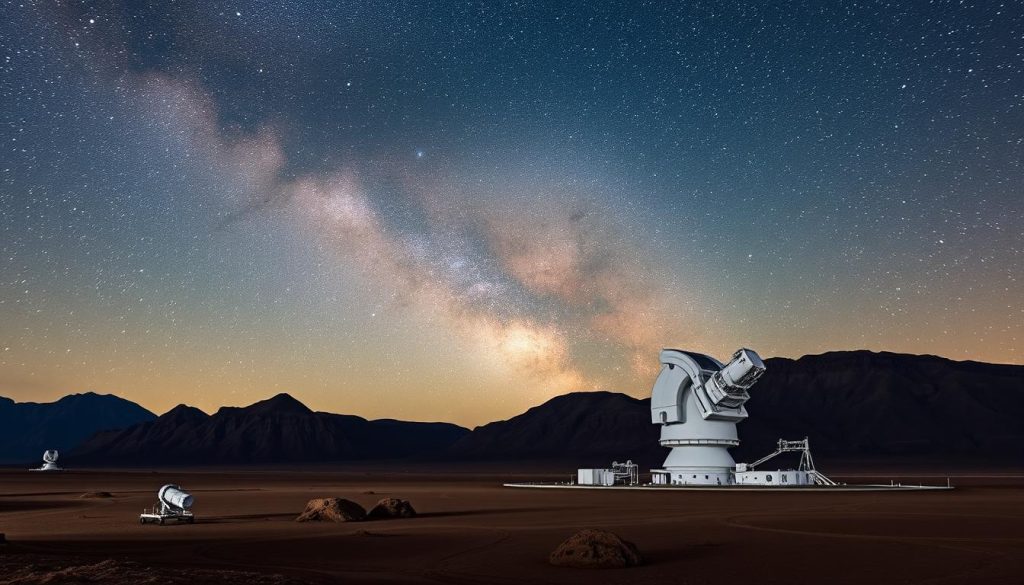
Messier’s Cosmic Treasures
Charles Messier didn’t focus on exoplanets, but his work is still key for astronomers. The Dumbbell Nebula (M27) is a great example of a planetary nebula. It’s a type of emission nebula made when a star sheds its outer layers. M27 and other Messier objects are still fascinating to astronomers and the public, helping us learn more about our universe.
The Messier catalog was made in the late 18th century. It lists many types of celestial objects, like star clusters and galaxies. These Messier objects are crucial for both experts and hobbyists. They give us a lot of information about the different bodies in our cosmos.
- Planetary nebulae, such as the Dumbbell Nebula (M27), are made when a star explodes, creating beautiful structures.
- Emission nebulae, like the Orion Nebula (M42), are gas and dust clouds that light up the space around them.
- The Messier catalog also has many astronomical classifications, like globular and open clusters. Each one tells us something about how our universe formed and evolved.
| Messier Object | Type of Object | Interesting Fact |
|---|---|---|
| M27 (Dumbbell Nebula) | Planetary Nebula | This nebula was the first planetary nebula to be discovered, in 1764 by Charles Messier. |
| M42 (Orion Nebula) | Emission Nebula | The Orion Nebula is one of the most studied and photographed objects in the night sky, and is visible to the naked eye. |
| M13 (Hercules Globular Cluster) | Globular Cluster | M13 is one of the brightest and most prominent globular clusters in the northern celestial hemisphere. |
Messier’s main goal was to list objects that could be mistaken for comets. But his work has greatly helped us understand our universe. From the stunning planetary nebulae to the breathtaking emission nebulae, the Messier catalog keeps inspiring and teaching us.
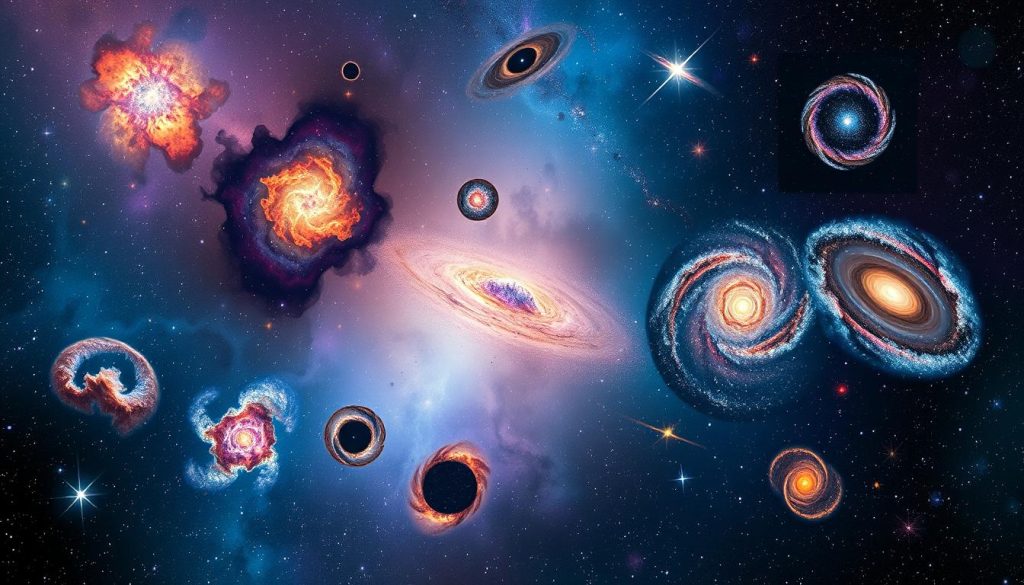
Exoplanets: A Diverse Galactic Menagerie
The search for exoplanets has shown us a wide range of alien worlds. We see everything from the very hot hot Jupiters to possible homes for life, like super-Earths and mini-Neptunes. This variety challenges our old ideas about how planets form and what life needs to exist. As we learn more about these distant worlds, our view of the universe keeps changing, leading to new discoveries.
In March 2022, we found 5,000 known exoplanets. This is a big step forward in space exploration. These planets are all different from each other and from Earth. By studying them, we can group them and find patterns.
Research shows that super-Earths, planets up to twice as big as Earth, might be the most common. Scientists have also found other types, like planets that evaporate or are very dense. This variety shows how diverse the galaxy can be.
With all this data, scientists hope to understand how planets develop. They want to find Earth-like planets and maybe even life. They’re using new technologies like next-generation telescopes to help.
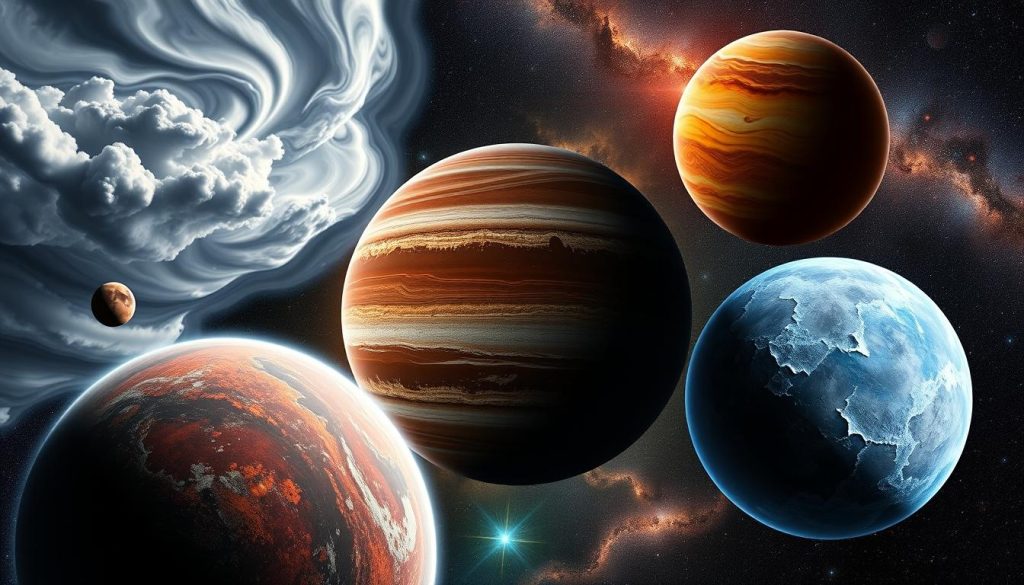
The search for exoplanet diversity is expanding our knowledge of the universe. With every new find, we get closer to knowing if we’re alone in the cosmos.
The Extremely Large Telescope: A Game-Changer
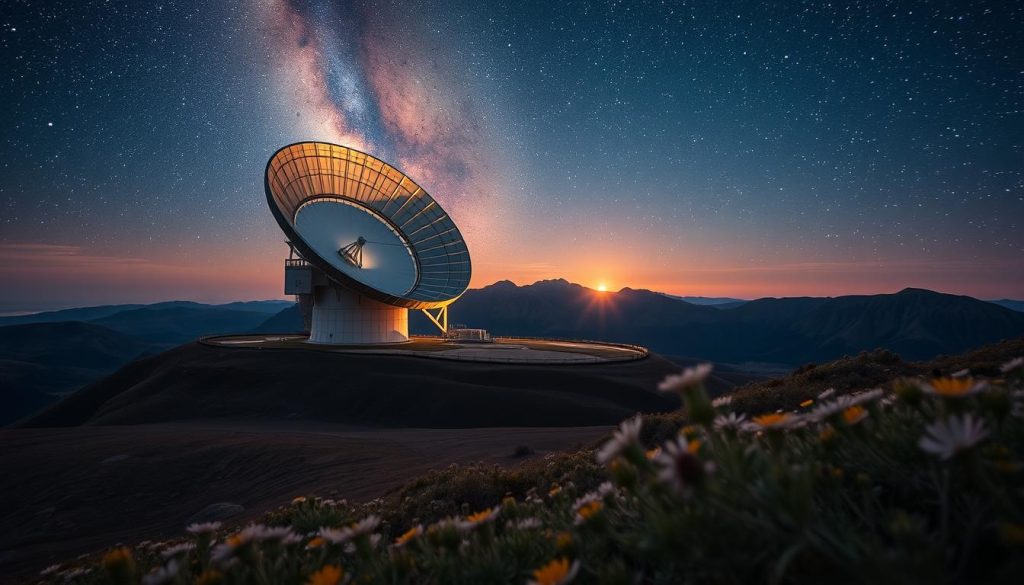
The Extremely Large Telescope (ELT) is set to change the game in finding exoplanets. Its ANDES instrument will spot smaller, rocky planets around distant stars. This is beyond what current telescopes can do. It will help us learn about exoplanetary atmospheres and search for signs of life, bringing us closer to finding habitable worlds.
 Constellations: History and Significance
The ELT’s huge 39-meter mirror will gather more light than any other ground-based telescope. This means it can see fainter and more distant objects. The ANDES instrument will use special techniques to study the chemistry of exoplanet atmospheres, giving us key insights into their habitability.
Astronomers will get to study small, rocky exoplanets in new ways with the ELT. This will help us understand how planets form and the variety of worlds in our galaxy. The ELT’s groundbreaking abilities will change how we see the universe and our place in it, as we explore exoplanet detection and atmospheric studies.
| Telescope | Primary Mirror Diameter | Purpose |
|---|---|---|
| Extremely Large Telescope (ELT) | 39 meters | Exoplanet detection and atmospheric characterization |
| Hubble Space Telescope | 2.4 meters | General astronomical observations |
| James Webb Space Telescope (JWST) | 6.5 meters | Infrared observations, exoplanet characterization |
Unraveling the Mysteries of Exoplanetary Atmospheres
Astronomers are finding more exoplanets than ever before. Now, they focus on understanding their atmospheres. By studying these atmospheres, scientists can find signs of water, methane, or oxygen. This helps them know if these planets could support life.
The search for biosignatures is key in this research. Biosignatures are signs of life. Finding them could help us find planets that might have life.
Advanced tools like the James Webb Space Telescope are helping scientists learn about atmospheric composition. They are studying the atmospheres of different planets. This includes hot Jupiters and planets that might be like Earth.
Exploring the universe, studying exoplanet atmospheres is crucial. It helps us understand if other planets can support life. This search is exciting and could lead to finding life beyond our planet.
| Satellite | Mass (kg) | Length (m) |
|---|---|---|
| International Space Station (ISS) | 420,000 | 109 |
| Hubble Space Telescope | 11,000 | 13.2 |
| Terra (EOS) | 5,190 | 7 x 12 |
| Envisat | 8,211 | 26 |
| GOES-R series | 5,192 | N/A |
| TDRS-3 | 2,270 | N/A |
| Inmarsat-4 F1 | 5,960 | N/A |
The James Webb Space Telescope (JWST) found something interesting about Centaur 29P/Schwassmann-Wachmann 1. It saw jets of gases like carbon monoxide and carbon dioxide. This suggests Centaur 29P might be made of different parts.
This finding could lead to more research on similar objects in our solar system. It helps us understand how the early solar system evolved. Studying Centaur 29P’s outbursts can give us insights into its formation and behavior.

Citizen Science: Astronomy’s Crowdsourcing Revolution
Citizen science has become a key player in astronomy, letting amateur astronomers make big contributions. Projects like Planet Hunters and the Visual Survey Group show how the public can help professionals. Together, they find rare and unexpected things in space, like new planets.
The discovery of a fast-moving triple-star system shows the power of citizen science. Amateur astronomers work with pros to spot interesting patterns in big data, like NASA’s TESS mission. This teamwork opens up new ways to explore our galaxy.
Citizen science projects also build a community and get people excited about space. For example, Galaxy Zoo has thousands of volunteers worldwide. They’ve helped publish over 60 papers and found cool things like Hanny’s Voorwerp and Green pea galaxies.
As we explore the universe, citizen science keeps getting stronger. NASA’s challenges, like the Watts on the Moon Challenge and the Airport Throughput Prediction Challenge, show NASA’s commitment to teamwork. This teamwork lets us explore the universe even further.
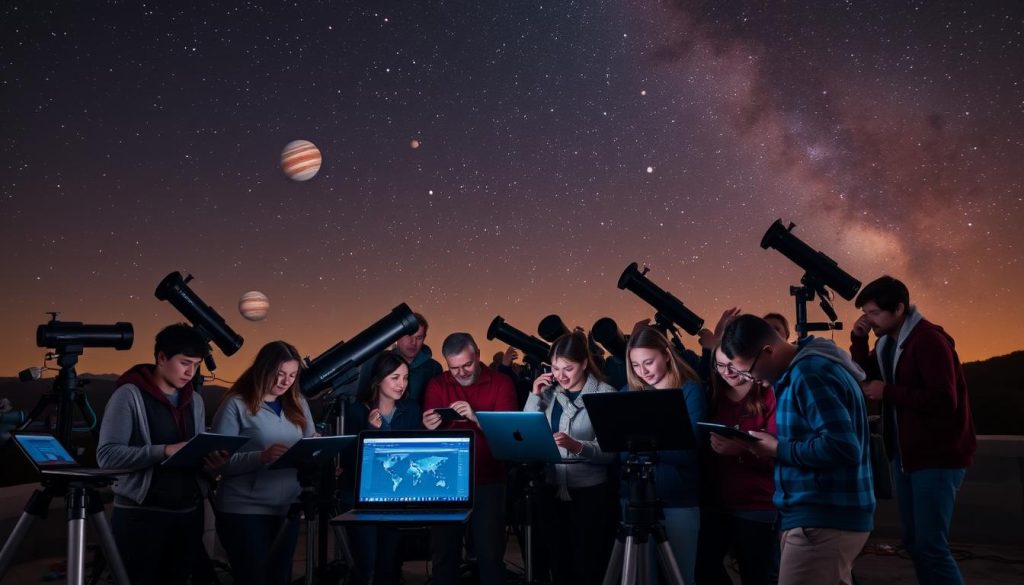
The future of astronomy looks bright with citizen scientists on board. As we learn more about distant worlds, amateur astronomers will be key. They help us understand the universe better.
The Search for Habitable Worlds
The main goal of exoplanet research is to find Earth-like planets that might have life. Scientists look for planets in the habitable zones of their stars. These zones are where liquid water could exist on the planet’s surface.
Finding biosignatures, signs of life, in these planets’ atmospheres would be a huge discovery. It would be a major step in the search for life outside our planet.
Earth’s Twins: The Quest for Life Beyond Our Solar System
New telescope technologies are helping us find Earth’s cosmic twins. These discoveries are exciting scientists and the public. For example, a study found a lot of water vapor in the atmosphere of GJ 9827 d, a planet about two times the size of Earth.
By using data from the James Webb Space Telescope and the Hubble Space Telescope, researchers analyzed GJ 9827 d’s atmosphere. This shows how we can now better find Earth-like planets and see if they can support habitable environments. This discovery is a big step towards finding habitable exoplanets that might have life.
NASA’s Habitable Worlds Observatory (HWO) is focused on finding life beyond our Solar System. It aims to study Earth-like planets at any stage of their development. By improving the HWO’s ability to detect planets, scientists hope to understand more about the habitability of terrestrial exoplanets. This could help us learn about Earth’s cosmic twins.

Exoplanets: Rewriting Our Cosmic Lexicon
The discovery of exoplanets has changed how we see the universe. We now know about the wide variety of alien worlds. Each new find teaches us more about how planets form and evolve.
 Dark Matter and Dark Energy: The Great Mysteries of the Universe
These discoveries have opened our eyes to the diversity of planets. We’ve found everything from hot Jupiters to planets that might support life. This has made us rethink how planets come to be.
As we learn more about exoplanets, our view of the universe changes. The discovery of diverse alien worlds sparks our curiosity. It drives us to explore the universe even more.


