

Gas Laws: Behavior of Gases Under Different Conditions

The world is facing big challenges due to climate change. The World Meteorological Organization (WMO) said 2023 was the hottest year ever. This shows how urgent our environmental problems are.
The Amazon River basin is experiencing a severe drought. This is made worse by El Niño. It’s affecting the balance of ecosystems and hydroelectric power, which many countries depend on. This crisis has led us to study the gas laws more closely.
It’s important to understand how gases behave. This includes their pressure, volume, temperature, and amount. Knowing this helps us solve many problems in industries, the environment, and science.
For example, it helps reduce air pollution from diesel generators in poor countries. It also makes power generation and energy storage more efficient. The gas laws are key to understanding our world.
Introduction to Gas Laws
Gas laws explain how gases behave. They cover pressure, volume, temperature, and gas amount. These laws are key in chemistry, physics, engineering, and meteorology.
Importance of Gas Laws
Gas laws are very important for several reasons:
- They help us understand gas behavior, which is vital in science and industry.
- They predict gas properties like density and expansion. This is crucial for designing equipment.
- They explain gas behavior in processes like combustion and respiration.
- They are the basis for many scientific theories and models.
Overview of Different Gas Laws
The main gas laws are:
- Boyle’s Law: Shows how pressure and volume of a gas are related, keeping temperature and gas amount constant.
- Charles’s Law: Reveals how volume and temperature of a gas are connected, with constant pressure and gas amount.
- Avogadro’s Law: States that volume and gas amount are directly related, with constant pressure and temperature.
- Dalton’s Law of Partial Pressures: Explains how total pressure of a gas mix relates to individual gas pressures.
These laws, along with the Ideal Gas Law, give a full picture of gas behavior under different conditions.
Ideal Gas Law
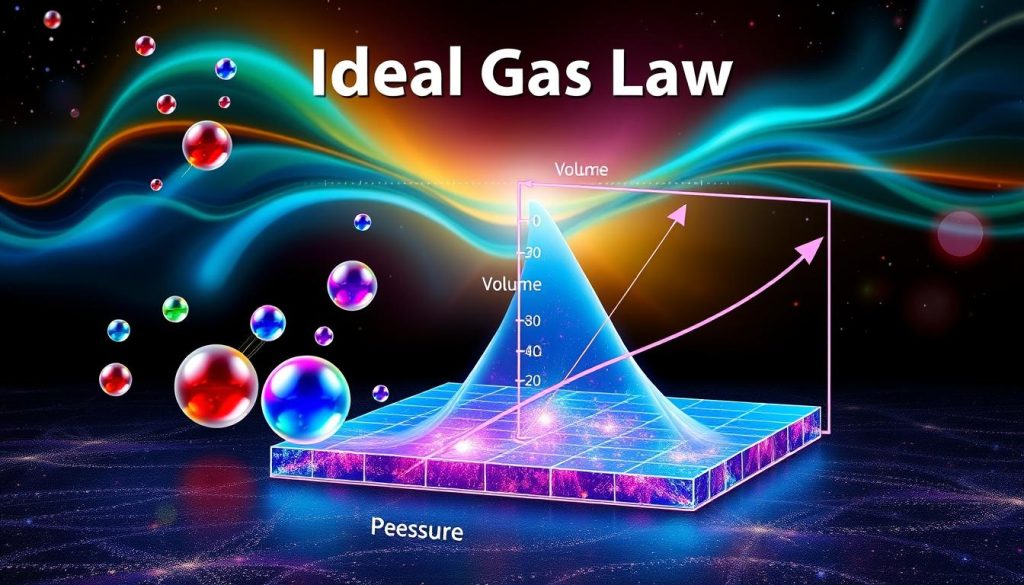
The ideal gas law is key in studying gas behavior. It connects pressure, volume, temperature, and gas amount. It’s a mix of earlier gas laws and is used in many fields.
Derivation of Ideal Gas Law
The law comes from the kinetic theory of gases. This theory explains how gas molecules move and interact. The equation for the ideal gas law is:
PV = nRT
Where:
- P is the gas pressure
- V is the gas volume
- n is the gas amount in moles
- R is the universal gas constant
- T is the gas temperature
Applications of Ideal Gas Law
The ideal gas law is used in many areas. Here are a few:
- Thermodynamics: It helps study gas behavior in thermodynamic processes.
- Engineering: It’s used in designing and analyzing systems like engines and refrigerators.
- Chemistry: It helps calculate gas molar mass and study gas reactions.
- Meteorology: It aids in understanding atmospheric gases and weather patterns.
The ideal gas law is crucial for predicting gas behavior. It’s used in many scientific and engineering fields.
Boyle’s Law
Boyle’s law is a key principle in studying gas behavior. It shows how pressure and volume of a gas are related. The law says that as the volume of a gas goes up, its pressure goes down. This happens when the temperature and amount of gas stay the same.
Mathematically, Boyle’s law is shown as:
P ∝ 1/V
Here, P is the gas’s pressure, and V is its volume. So, if the volume gets bigger, the pressure gets smaller. And if the volume gets smaller, the pressure gets bigger.
Boyle’s law is used in many areas like science, engineering, and daily life. It helps us understand how gases work in things like aircraft, scuba gear, and car engines.
Knowing how pressure and volume are connected helps scientists and engineers make systems work better. They can improve how devices that use gases perform.

Boyle’s law also has real-life uses. For example, it explains why you need to push hard to inflate a balloon. This makes the balloon’s volume smaller and its pressure higher. When you let go, the balloon gets bigger and its pressure goes down.
In summary, Boyle’s law is crucial for understanding gas behavior. It has many uses in science and everyday life.
Charles’s Law
Charles’s law is named after French scientist Jacques Charles. It explains how the volume of a gas changes with its temperature. This happens when the pressure and amount of gas stay the same.
 Electromagnetism: The Force That Moves the Universe
 Mathematically, Charles’s law is shown as: V = k × T. Here, V is the gas volume, T is the absolute temperature, and k is a constant. It depends on the gas and the units used.
This law is key to understanding gas behavior. When a gas gets hotter, its volume goes up. If it gets cooler, its volume goes down.
Charles’s law is used in many areas. It helps in making hot air balloons and gas engines. It also helps us understand the atmosphere and gas reactions in chemistry.
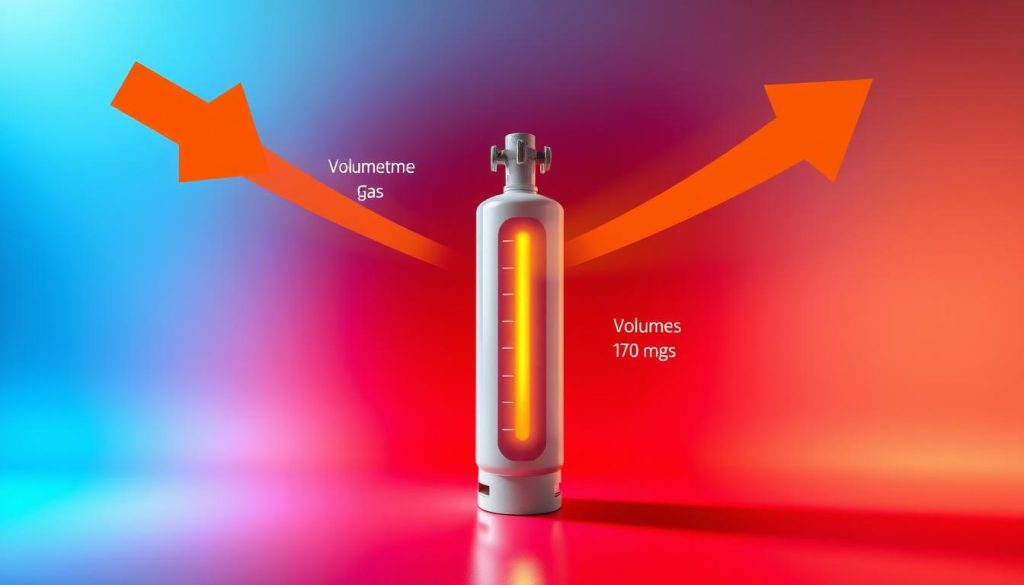
The image shows how Charles’s law works. When the temperature goes up, so does the gas volume. And when the temperature goes down, the volume goes down too.
Avogadro’s Law
In the world of gas laws, Amedeo Avogadro, an Italian physicist, made a big impact. His law says that under the same temperature and pressure, gases of the same volume have the same number of molecules. This idea is key to understanding how gases work and their properties.
Avogadro’s law focuses on the link between a gas’s volume and the amount of gas, measured in moles. It shows that at a constant temperature and pressure, a gas’s volume grows with the number of moles. So, if you add more gas, its volume will also go up, and vice versa.
This law has big implications. It helps scientists predict and control gas behavior in many areas. For example, it’s vital in figuring out chemical reactions, where knowing the volumes of reactants and products is based on moles.
| Example | Values |
|---|---|
| Volume of 40 moles of a gas | 0.82 m³ |
| Pressure of 0.1 moles of a gas at 50 °C | 268.7 Pa or 0.00265 atm |
Avogadro’s law is part of the ideal gas law. This law combines Boyle’s, Charles’s, and Avogadro’s laws. The equation PV = nRT lets us figure out gas properties like pressure, volume, temperature, and moles, with the right information.

Avogadro’s work changed physical chemistry forever. His ideas about molecules and atomic weights helped us understand matter and gas behavior better. His law and Avogadro’s number are now key parts of science history.
Gas Laws
Understanding gases is key in science and engineering. The gas laws explain how gases act under different conditions. They cover pressure, volume, temperature, and amount of substance. Knowing these gas laws helps us understand gas behavior and its uses.
The ideal gas law is a key concept. It connects pressure, volume, temperature, and amount of gas. It’s based on Boyle’s, Charles’s, and Avogadro’s laws. This law helps predict gas behavior under various conditions.
Other gas laws are important too. Boyle’s law shows how pressure and volume are related. Charles’s law links volume and temperature. Avogadro’s law connects volume and amount of substance.
These gas laws help scientists and engineers design gas-related systems. They’re used in many fields, from industry to the environment. The knowledge from gas laws leads to new discoveries in thermodynamics, chemistry, and physics.
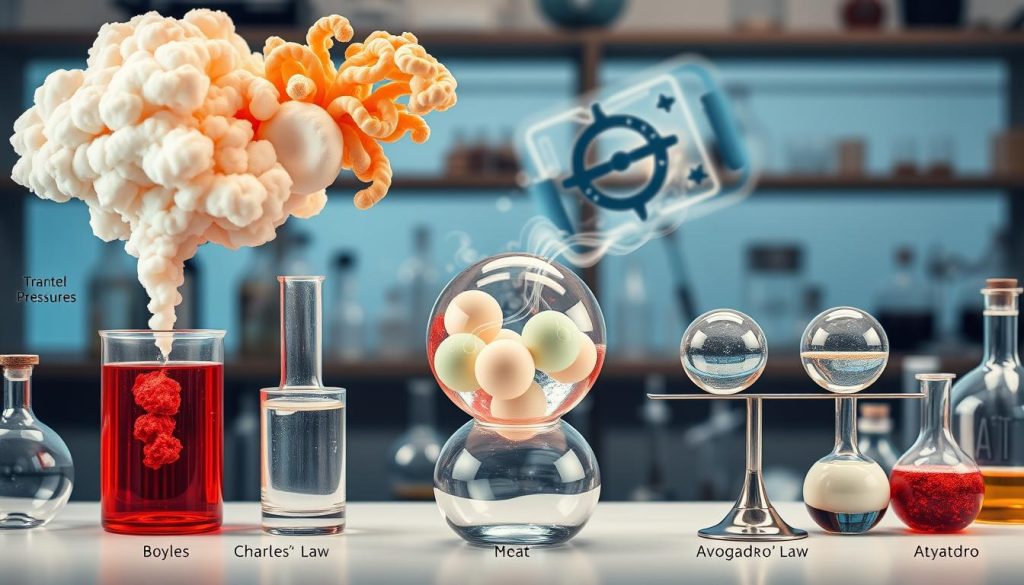
In short, the gas laws give us a deep understanding of gases. This knowledge is used in many areas and helps in scientific progress.
Partial Pressure and Dalton’s Law
Understanding partial pressure is key when working with gas mixtures. Partial pressure is the pressure each gas adds to the total pressure. Dalton’s Law says the total pressure of a gas mix is the sum of each gas’s partial pressure.
Calculating Partial Pressures
To find a gas’s partial pressure in a mix, use this formula:
Partial Pressure = (Mole Fraction of Gas) × (Total Pressure)
The mole fraction is the gas’s moles divided by the total moles in the mix. With mole fractions and total pressure, you can find each gas’s partial pressure.
| Gas | Mole Fraction | Partial Pressure (atm) |
|---|---|---|
| Nitrogen (N₂) | 0.78 | 0.78 |
| Oxygen (O₂) | 0.21 | 0.21 |
| Carbon Dioxide (CO₂) | 0.01 | 0.01 |
| Total | 1.00 | 1.00 |
Knowing about partial pressure and Dalton’s Law helps you figure out each gas’s role in a mix. This is vital for many fields, like respiratory systems, chemical processes, and environmental studies.
Kinetic Theory of Gases
The kinetic theory of gases is key in studying gas laws and gas behavior. It explains how gases act under different conditions. This theory looks at the big picture of gases, like pressure and volume, by focusing on the tiny actions of gas molecules.
Assumptions of Kinetic Theory
The kinetic theory of gases relies on a few main ideas:
- Gases are made up of many small, moving particles (molecules).
- These molecules move fast and randomly, bumping into each other and the container walls.
- These collisions are elastic, meaning no energy is lost.
- The energy of the molecules is tied to the gas’s temperature.
- The molecules are very small compared to the container, and they don’t attract or repel each other much.
These ideas help us understand how gases behave. They explain why gases expand and how they react to temperature and pressure changes.
 Newton’s Laws: Fundamentals of Classical Physics
The kinetic theory of gases has greatly helped us understand gas properties and behavior. It’s the foundation for gas laws like the Ideal Gas Law. It also helps us understand the assumptions of kinetic theory.
Gas Constant and Molar Volume
The gas constant and molar volume are key in studying gas laws. The gas constant, R, links pressure, volume, amount of substance, and temperature of an ideal gas. It’s about 8.314 J/(mol·K) and used in the Ideal Gas Law.
The molar volume is the space one mole of gas takes up at certain temperatures and pressures. At standard conditions, it’s about 22.4 liters per mole. This number is important for gas-related calculations and uses.
Key Points:
- The gas constant, R, is a fundamental physical constant that relates the pressure, volume, amount of substance, and absolute temperature of an ideal gas.
- The gas constant has a value of approximately 8.314 J/(mol·K) and is used in the Ideal Gas Law equation.
- The molar volume is the volume occupied by one mole of a gas under specific conditions of temperature and pressure.
- At standard temperature and pressure (STP) conditions, the molar volume of an ideal gas is approximately 22.4 liters per mole.
Knowing the gas constant and molar volume is crucial. It helps in designing and analyzing chemical processes, thermodynamic calculations, and studying gas phenomena.

Van der Waals Equation
The ideal gas law is great for gases, but it has its limits. The van der Waals equation fixes these by adding in molecule interactions and their size.
Limitations of Ideal Gas Law
The ideal gas law sees gas molecules as tiny points with no size and no interaction. But, real molecules have size and pull towards each other. This matters a lot at high pressures or cold temperatures, where the ideal gas law doesn’t work.
Van der Waals Equation Derivation
The van der Waals equation includes molecule size and attraction. It’s made by tweaking the ideal gas law to fit these real-world aspects. This gives a better picture of how gases act under different situations.
The van der Waals equation looks like this:
(P + a/V^2)(V – b) = RT
Where:
- P is the pressure of the gas
- V is the volume of the gas
- T is the absolute temperature
- R is the universal gas constant
- a and b are the van der Waals constants specific to the gas
The constants a and b stand for molecule attraction and size. With these, the van der Waals equation does a better job of predicting gas behavior. It’s especially good when the ideal gas law doesn’t cut it.

Applications of Gas Laws
The gas laws explain how gases behave under different conditions. They are used in many industries and help us understand our environment. Knowing these laws is key to many practical uses.
Industrial Applications
The applications of gas laws are seen in many industrial areas. For example, the Ideal Gas Law helps design compressors and engines. Boyle’s Law and Charles’s Law are used in making storage tanks and pneumatic systems.
In the chemical and petrochemical fields, gas laws are vital. They help in setting up reactions, designing distillation columns, and moving natural gas safely.
Environmental Applications
The applications of gas laws also affect our environment. They help us understand the Earth’s atmosphere and greenhouse gases. This knowledge is crucial for studying climate change.
- The Ideal Gas Law helps scientists predict weather and track environmental impacts.
- The Dalton’s Law of Partial Pressures is key for air quality and environmental policies.
- The Kinetic Theory of Gases sheds light on pollutant transport, aiding in pollution prediction and control.
As we face environmental issues, gas laws remain essential. They help us tackle climate change, improve air quality, and manage natural resources sustainably.

Experimental Verification of Gas Laws
Understanding how gases behave is key. Many studies have been done to check if gas laws really work. These experiments have helped us see how gas laws apply in real life, from factories to the environment.
One important area is studying gas mixtures. Scientists have looked at how gases like methane and oxygen react together. They’ve learned about things like emissions and how well fires burn.
Math and computer models are also important. They help us understand gas interactions. Researchers have used these tools to study things like fast-moving gas flows and how gases mix in fires.
| Year | Publication | Gas Mixtures Studied | Key Findings |
|---|---|---|---|
| 2012 | Izv. Vuz. Av. Teknika | Methane, Hydrogen, Oxygen | Investigated the influence of plasma ignition on combustion efficiency and emissions |
| 2021 | Journal of Physics D: Applied Physics | Argon, Nitrogen, Carbon Oxides | Analyzed the role of gas-dynamic stimulation in improving combustion chamber performance |
| 2018 | Acta Astronautica | Ethanol, Aqueous Solutions | Explored the use of numerical simulations to study the ignition delays of alternative fuels |
| 2000 | Izv. Vuz. Av. Teknika | Methane, Hydrogen, Oxygen | Investigated the impact of plasma-assisted combustion on emissions and combustion efficiency |
These studies, along with math and computer models, have helped us understand gas laws better. What we’ve learned can help make things better, from factories to the environment.

Deviations from Gas Laws
The gas laws help us understand how gases act under different conditions. But, real-world situations often don’t follow these laws perfectly. This is because of things like the size of gas molecules and forces between them. Also, temperature and pressure can play a role.
 Water Chemistry: Properties and Their Importance
 The Van der Waals equation is a key example of this. It considers the size of gas molecules and the forces between them. This equation is more accurate than the ideal gas law, especially at high pressures or low temperatures.
Also, gases with impurities or mixtures can behave differently than expected. We need to think about how different gases interact and their solubility. Knowing these differences is important for improving industrial processes and creating new technologies.


