

Newton’s Laws: The Fundamentals of Mechanics

Introduction to Newton’s Laws of Motion
Sir Isaac Newton, one of the most influential scientists in the history of physics, formulated three fundamental laws that govern the behavior of moving objects. These laws, known as Newton’s Laws , laid the foundation for classical mechanics , allowing us to understand how objects respond to forces and how they move.
Newton’s laws are essential for the study of mechanics and have been key in the development of scientific and technological disciplines, from engineering to astronomy.
First Law of Motion: The Law of Inertia
Newton’s first law , also known as the law of inertia , states that:
“Every body remains in its state of rest or uniform rectilinear motion unless an external force acts on it.”
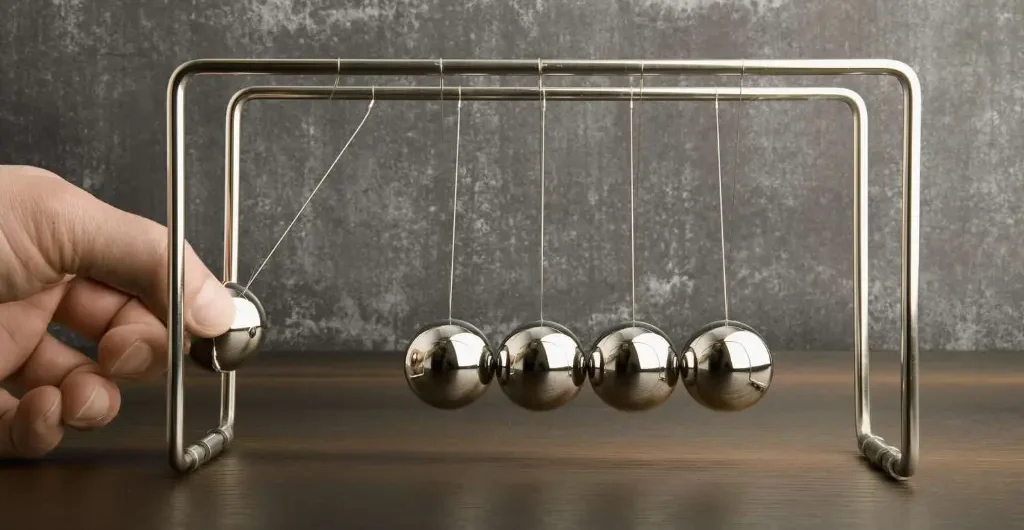
This law describes the resistance of an object to changing its state of motion, whether it is at rest or in constant motion. “Inertia” is the property that bodies have of resisting changes in their speed.
Examples of the Law of Inertia
- Moving car : If you are riding in a car that brakes suddenly, your body tends to continue moving forward due to inertia, which explains why seat belts are essential.
- An object at rest : A book on a table will not move unless an external force is applied, such as pushing on it with your hand.
The law of inertia teaches us that objects do not change their state of motion unless an external force, such as friction or a collision, forces them to do so.
 String Theory: Unveiling the Fabric of the Universe
 Second Law of Motion: The Law of Force and Acceleration
Newton’s second law is expressed mathematically as:
F = ma, where:
- F is the applied force.
- m is the mass of the object.
- a is the acceleration produced.
This law states that the acceleration of an object is directly proportional to the force applied to it and inversely proportional to its mass. In other words, the more massive an object is, the more difficult it is to change its velocity.
Breakdown of the Second Law
- Force (F) : Force is any interaction that can change the motion of an object. It can be a push, pull, gravity, friction, etc.
- Mass (m) : Mass is the amount of matter in an object and determines its resistance to acceleration when a force is applied to it.
- Acceleration (a) : Acceleration is the change in velocity of an object per unit of time.
Examples of the Second Law
- Pushing a shopping cart : The more loaded the cart is (greater mass), the harder it is to accelerate, which requires applying greater force.
- Throwing a ball : If you throw two balls, one light and one heavy, with the same force, the lighter ball will accelerate faster.
Newton’s second law is fundamental to understanding how forces influence motion and how weight and mass affect an object’s response to those forces.
Third Law of Motion: The Law of Action and Reaction
Newton’s third law is perhaps the most famous and states that:
“For every action, there is an equal and opposite reaction.”
Inorganic Chemistry: Differences and Applications
This means that when one object exerts a force on another, the second object exerts a force of equal magnitude but in the opposite direction on the first. This law explains why objects not only react to forces, but also interact with each other.
Examples of the Law of Action and Reaction
- Walking : When you walk, you push the ground back with your feet (action), and the ground pushes you forward (reaction), allowing movement.
- Rocket takeoff : The rocket engine expels gases downward (action), and in reaction, the rocket is pushed upward.
- Swimming : By pushing the water back with your arms, the water pushes your body forward, allowing you to move forward.
Newton’s third law emphasizes that forces always act in pairs and that every action has a direct consequence, which is essential to understanding phenomena such as the flight of airplanes, the movement of vehicles, and many other practical applications.
Applications of Newton’s Laws in Everyday Life
Newton’s laws not only explain complex motions in advanced physics, but are also fundamental to everyday functioning in the world around us. Here are some examples of how these laws apply:
1. Transportation
- Automobiles : The motion of vehicles is governed by Newton’s three laws. The first law explains the need for brakes and the second describes how a car’s acceleration is related to the force of the engine and the mass of the vehicle.
- Airplanes and Boats : The action-reaction principles of the third law explain how airplane and boat engines generate propulsion. For example, in a jet airplane, gases expelled backward produce a force that pushes the airplane forward.
2. Sports
- Football : When you kick a ball, the force you apply to the ball (second law) accelerates it in the direction you kick it. At the same time, the ball applies a reaction force to your foot (third law).
- Cycling : As you pedal, the bike moves forward because you apply a force on the pedals, and the ground pushes back due to friction.
3. Construction and Engineering
- Bridges and Buildings : Engineers use Newton’s laws to calculate the forces that affect structures, ensuring that buildings can withstand external forces such as wind and earthquakes.
- Cranes and Heavy Machinery : Newton’s laws help calculate the force needed to lift or move heavy objects, such as building materials.
Newton’s Laws and Space Exploration
Newton’s laws are fundamental to space exploration. From rocket launches to satellite orbits, these laws explain how forces and motion interact in space.
- Rocket Launch : Newton’s third law, the law of action and reaction, is key to understanding how rockets are launched into space. Gases expelled downward create a thrust force that allows the rocket to rise.
- Satellites in orbit : Once in space, Newton’s first law explains how satellites remain in constant motion unless some external force (such as atmospheric drag or gravity) acts on them.
Conclusion
Newton’s Laws are the foundation of classical mechanics and have revolutionized our understanding of the universe. From explaining how objects move to predicting how forces act on them, these laws are essential both in our daily lives and in scientific and technological advancements.
Thanks to Newton, we can predict and manipulate the motion of objects, from the fall of an apple to the journey of a spaceship through the cosmos. Understanding and applying these laws has enabled the evolution of modern physics and engineering, making
 Law of Conservation of Mass: Why Does It Matter?


