
Leonardo da Vinci’s Greatest Inventions Ahead of His Time
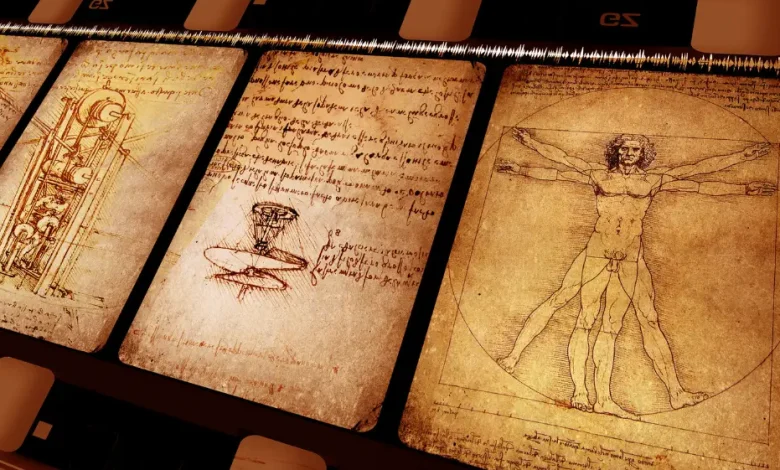
Leonardo da Vinci, one of history’s greatest minds, was not only a master artist but also a visionary inventor ahead of his time. His sketches and designs, which spanned centuries beyond the technological capabilities of his era, reveal a profound understanding of mechanics, anatomy, and engineering. In this article, we explore some of da Vinci’s most remarkable inventions that continue to inspire modern science and innovation.
The Flying Machine: A Dream of Soaring Through the Sky
One of da Vinci’s most famous inventions was his concept for a flying machine. Inspired by the birds and the human fascination with flight, he drew detailed designs for a device resembling a modern-day helicopter. This machine, often referred to as the “aerial screw,” had a spiral shape that would theoretically allow it to lift off the ground using a screw mechanism to generate lift.
- Key Features: A helical screw design, resembling a modern helicopter rotor.
- Functionality: Intended to be powered by human strength, with a structure to generate lift.
- Legacy: Although it never flew, the concept influenced later aerodynamics and aircraft designs.
The Vitruvian Man: Merging Art and Science
While not an invention in the traditional sense, da Vinci’s Vitruvian Man is a key representation of his understanding of human proportions and anatomy. This drawing showcases the connection between art and science, demonstrating how the body can be divided into geometrically proportional parts. It reflects his belief that human anatomy could be studied and understood mathematically, blending artistic precision with scientific knowledge.
 How Einstein Revolutionized Physics with the Theory of Relativity
The Parachute: A Leap Towards Safety
Da Vinci also envisioned the parachute, a device designed to slow the fall of a person from great heights. His concept was a large, pyramid-shaped canopy made from linen, which would deploy in mid-air to slow the descent. While it was never tested in da Vinci’s lifetime, modern tests have shown that the parachute would have worked as intended, making it one of his forward-thinking inventions.
- Design: A pyramid-shaped canopy made of linen and supported by a wooden frame.
- Purpose: To slow the descent of a person from great heights and ensure safety.
- Impact: The modern parachute is based on similar principles, proving da Vinci’s brilliance.
The Armored Vehicle: The Prototype Tank
Another of da Vinci’s incredible inventions was the design for an armored vehicle, which is considered a precursor to the modern tank. This vehicle, depicted in his sketches, was made of a circular, armored shell with cannons positioned around its exterior. Powered by human or animal effort, it was meant to be a mobile fortress capable of advancing on enemy lines while offering protection to its occupants.
- Design Features: A circular, armored shell with cannons and a rotating turret.
- Mechanism: The vehicle was intended to be powered by humans or animals walking on treadmills.
- Historical Impact: Though never built, it foreshadowed the development of modern military tanks.
The Self-Propelled Cart: Early Automobile Concept
In addition to his military inventions, da Vinci designed a self-propelled cart, which is considered one of the first concepts of the modern automobile. The cart was powered by springs and could move without the need for external propulsion. This design shows da Vinci’s deep understanding of mechanics and motion, as well as his vision for transportation far beyond the capabilities of his time.
 Galileo Galilei: The Father of Modern Astronomy
- Design: A cart with a mechanical system of gears and springs to provide motion.
- Significance: One of the earliest concepts of self-propulsion, leading to the automobile.
- Legacy: Influenced the development of later transport technologies, including the automobile.
The Anatomy Studies: Bridging Art and Medicine
Leonardo da Vinci’s anatomical studies were revolutionary, as he dissected human cadavers to gain a deeper understanding of the human body. These detailed sketches and diagrams helped bridge the gap between art and medicine. His meticulous observations of muscles, bones, and organs provided insights that would not be recognized in the medical field until centuries later.
- Methods: Dissection of cadavers, detailed sketches, and studies of human anatomy.
- Contributions: Improved understanding of the body’s internal systems, including the heart and vascular system.
- Legacy: His anatomical studies laid the groundwork for modern medicine and biology.
Conclusion: Da Vinci’s Legacy of Innovation
Leonardo da Vinci’s inventions and discoveries were far ahead of his time, touching on fields as diverse as aviation, anatomy, engineering, and transportation. His designs may not have been realized during his lifetime, but they continue to inspire innovation today. As one of the true pioneers of human thought, da Vinci’s inventions remind us of the power of imagination and the timeless pursuit of knowledge.
In summary, da Vinci’s inventions, such as the flying machine, parachute, armored vehicle, and self-propelled cart, stand as a testament to his genius. While many of his designs were not feasible in his day, their principles have been realized in modern technology. His legacy lives on, not just in his art but in the world-changing inventions that continue to shape our world.
 Rosalind Franklin: The Unsung Hero of DNA Discovery


