

The Truth Behind Isaac Newton and the Falling Apple
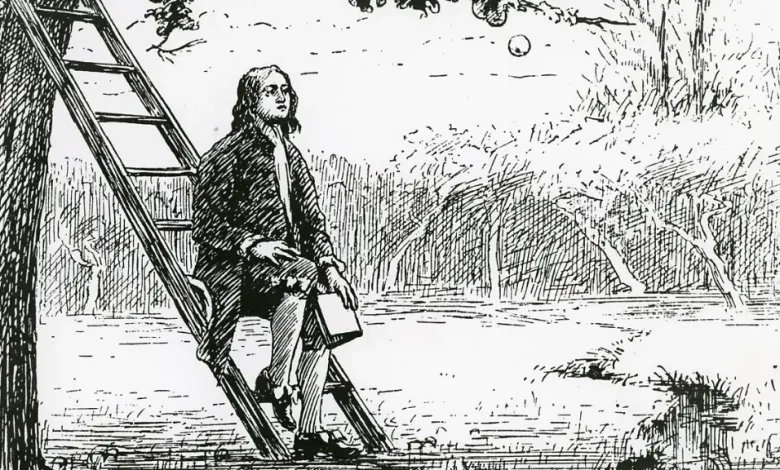
The story of Isaac Newton and the falling apple is one of the most well-known anecdotes in the history of science. Most of us have heard it in various forms: while sitting under a tree, Newton was struck by a falling apple, which led him to ponder the nature of gravity.
But how much of this story is actually true? Did an apple really lead to Newton’s groundbreaking discoveries, or has the story been embellished over time? Let’s dive into the facts behind the famous Isaac Newton apple story.
Did the Apple Really Fall on Newton’s Head?
One of the most popular versions of the story suggests that the apple fell and struck Newton on the head, jolting him into a revelation about gravitational force. However, historical records indicate that this detail is likely fictional. The story of the apple falling on his head is more of a myth than fact, though Newton did indeed observe an apple fall from a tree.
According to his friend and biographer, William Stukeley, Newton was inspired while watching an apple drop from a tree in his family’s orchard in Woolsthorpe, England. The sight of the falling apple supposedly led him to question why objects always fall downward rather than moving in another direction. This thought experiment would ultimately lay the foundation for his famous work on universal gravitation.
 Mary Anning: The Fossil Hunter Who Changed Paleontology
 Newton’s Formulation of Gravitational Law
Newton’s observation of the falling apple led him to develop his theories on gravity, which he later formulated mathematically. In his book Philosophiæ Naturalis Principia Mathematica (often referred to as the Principia), he introduced the concept of universal gravitation, expressed in the equation:
F = G * (m1 * m2) / r^2
where:
Fis the gravitational force between two masses.Gis the gravitational constant.m1andm2are the masses of two objects.ris the distance between the centers of the two masses.
This law of universal gravitation showed that every object in the universe is attracted to every other object by a force directly proportional to the product of their masses and inversely proportional to the square of the distance between them. This concept was revolutionary at the time and transformed our understanding of both celestial and terrestrial physics.
 Ada Lovelace: The World’s First Computer Programmer
 Separating Myth from Reality
As intriguing as the story of the apple hitting Newton may be, there are reasons to believe it was embellished over time. Here’s a closer look at the real elements versus the myths:
- True: Newton observed an apple fall from a tree, which led him to contemplate the nature of gravitational forces.
- Exaggerated: There is no evidence that the apple actually struck him on the head.
- Documented: Newton discussed this inspiration in later years, with records of the story coming from friends and biographers like Stukeley.
The apple story likely evolved to make Newton’s discovery more relatable, turning it into a simple narrative of cause and effect. In reality, Newton’s work was a complex development built on years of study, thought, and experimentation.
The Influence of the Apple Story on Modern Science
While the story of the apple might have been exaggerated, it serves an important purpose. It illustrates how simple observations can lead to profound insights, a concept that inspires scientists and inventors even today. Newton’s story is a reminder that curiosity about ordinary phenomena—like a falling apple—can spark revolutionary ideas.
In fact, this tale has influenced countless scientists who see Newton’s story as a metaphor for the power of asking “why.” In fields ranging from physics to biology, this curiosity-driven approach has led to innovations that continue to shape our world.
 Richard Feynman: The Life of a Curious Physicist
 Conclusion: Fact or Fiction?
The true story behind the Isaac Newton apple story lies somewhere between myth and reality. While it’s unlikely that an apple striking Newton’s head triggered an instant epiphany, his observation of a falling apple did play a role in his thoughts on gravity. Over time, this story has taken on a life of its own, symbolizing the power of curiosity and the importance of observation in scientific discovery.
Newton’s encounter with the apple tree reminds us that even the simplest events in nature can hold the answers to the universe’s greatest mysteries. By examining the real facts behind this legendary tale, we gain a deeper appreciation for Newton’s contributions and the enduring value of scientific curiosity.


