

Richard Feynman: The Life of a Curious Physicist
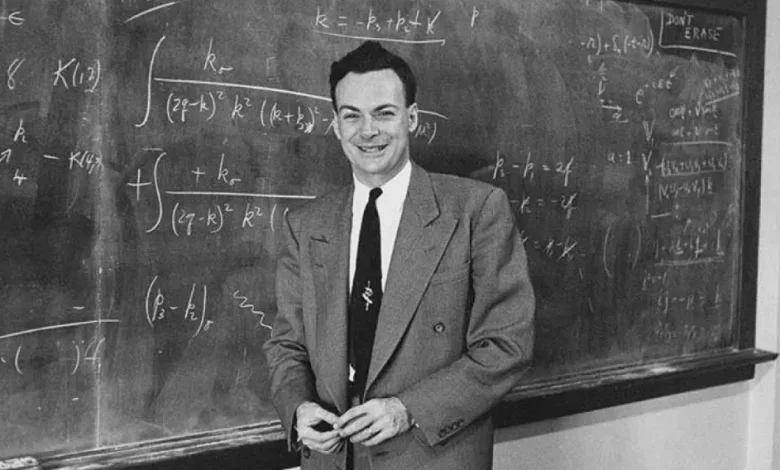
Richard Feynman curious life
Richard Feynman, one of the most celebrated physicists of the 20th century, was known not only for his groundbreaking work in quantum mechanics but also for his boundless curiosity and infectious enthusiasm. His life and contributions to science have inspired generations of thinkers and innovators. In this article, we delve into the curious life of Richard Feynman, exploring his early years, key scientific achievements, and his unique approach to life and learning.
Early Life and the Roots of Curiosity
Born on May 11, 1918, in Queens, New York, Richard Feynman displayed an intense curiosity from a young age. His father, a sales manager, encouraged him to ask questions and understand the world beyond superficial appearances. This encouragement would plant the seeds for Feynman’s lifelong quest to uncover the fundamental principles of nature.
- Educational Beginnings: Feynman’s exceptional talent in mathematics became evident early on. He taught himself advanced concepts in calculus and even invented his own symbols for mathematical operations.
- College Years: Feynman pursued his studies at MIT and later at Princeton, where he continued to excel, setting the stage for his later work in physics.
The Manhattan Project and Feynman’s Role in World War II
During World War II, Feynman joined the Manhattan Project, where he worked with other brilliant scientists on developing the atomic bomb. His unique perspective and knack for solving complex problems quickly made him a valuable asset to the project. Despite the seriousness of his work, Feynman approached it with his characteristic curiosity, constantly asking questions and exploring new ways to approach problems.
- Problem-Solving Techniques: Feynman developed innovative methods for solving engineering issues during the project, some of which were critical to its success.
- Philosophical Reflections: After the war, Feynman would reflect on the ethical implications of nuclear weapons, a subject that weighed heavily on him throughout his life.
Groundbreaking Contributions to Physics
After World War II, Feynman’s career in theoretical physics flourished. He made several contributions that would reshape modern physics, particularly in the field of quantum mechanics. Feynman’s insights and contributions to science were guided by his unique Feynman approach, a relentless drive to understand concepts in the simplest possible terms.
 Hypatia of Alexandria: The First Woman in Mathematics and Astronomy
 The Feynman Diagrams
One of Feynman’s most celebrated contributions is the Feynman diagram, a tool that provides a visual representation of the interactions between particles in quantum mechanics. This method allowed scientists to calculate complex interactions involving subatomic particles more intuitively.
- Feynman diagrams simplified complex calculations, making quantum electrodynamics (QED) more accessible to scientists.
- He shared the Nobel Prize in Physics in 1965 for his contributions to the development of QED, highlighting his role in shaping modern quantum theory.
Feynman’s Path Integral Formulation
Feynman’s path integral formulation in quantum mechanics introduced a novel way to calculate probabilities in quantum systems. In this approach, instead of following a single path, particles take all possible paths between two points, and the likelihood of each path is calculated. This concept is represented mathematically as:
∫ exp(iS/ħ) d(path)
where S is the action of the path, and ħ is the reduced Planck constant. This formulation was a revolutionary perspective and is still widely used in quantum field theory.
 How Dmitri Mendeleev Created the Periodic Table
 The Feynman Lectures and Teaching Style
As a professor, Feynman was known for his unconventional teaching style and ability to simplify complex ideas. He believed that if he couldn’t explain a topic simply, he hadn’t understood it deeply enough. Feynman’s passion for teaching is encapsulated in his famous lecture series, The Feynman Lectures on Physics, which remains a treasured resource for students and teachers alike.
- He often used stories, analogies, and humor to illustrate difficult concepts.
- Feynman’s “teach-back” method explaining topics in simple terms was a hallmark of his teaching style.
Beyond Physics: Feynman’s Other Passions
Feynman’s curiosity was not confined to physics; he explored many fields and hobbies, driven by a desire to understand the world in all its forms.
- Art and Drawing: Feynman learned to draw, often spending hours sketching people and scenes. He enjoyed art as another way to observe and interpret reality.
- Bongo Drumming: Known for his spontaneity, Feynman became an avid bongo player, performing with musicians and bringing a sense of playfulness to every pursuit.
- Safe-Cracking: Feynman famously developed an interest in safe-cracking while working at Los Alamos, showcasing his innate curiosity about how things worked.
Legacy of a Curious Physicist
Richard Feynman’s legacy is defined by his contributions to quantum mechanics, his innovative teaching methods, and his curiosity-driven life. He demonstrated that science and curiosity could coexist harmoniously, creating a life filled with discovery and wonder. Feynman’s approach to understanding the world, his insistence on questioning assumptions, and his joy in sharing knowledge continue to inspire curious minds today.
Feynman’s life reminds us that the essence of scientific discovery lies in the willingness to ask questions, challenge norms, and find joy in the pursuit of knowledge. As he once said, “I would rather have questions that can’t be answered than answers that can’t be questioned.”
 Louis Pasteur and the Birth of Vaccines


