

Ada Lovelace: The World’s First Computer Programmer
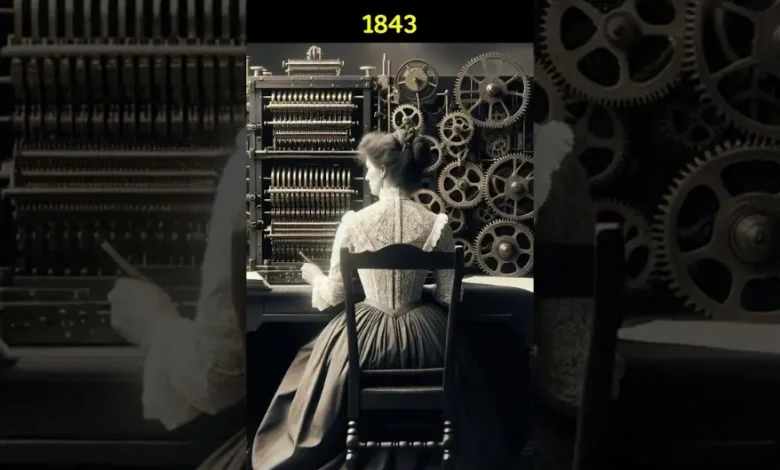
Ada Lovelace, often celebrated as the world’s first computer programmer, was a brilliant and visionary figure in the history of computing. Born Augusta Ada Byron in 1815, she was the daughter of the renowned poet Lord Byron and Lady Anne Isabella Byron.
Despite her father’s fame as a poet, Ada’s interests were deeply rooted in mathematics and science, leading her to make groundbreaking contributions in an era when women rarely participated in these fields.
The Early Life of Ada Lovelace
From a young age, Ada Lovelace displayed a unique combination of curiosity, intelligence, and determination. Her mother, Lady Byron, encouraged Ada’s interest in mathematics to prevent her from following in her father’s literary footsteps. Under her mother’s influence, Ada developed an intense focus on scientific studies, especially in mathematics and logic. This foundation would set the stage for her eventual collaborations and her visionary work in computing.
 Richard Feynman: The Life of a Curious Physicist
 Collaboration with Charles Babbage
In the 1830s, Ada was introduced to the mathematician and inventor Charles Babbage, who was working on an ambitious project: the Analytical Engine. The Analytical Engine was a proposed mechanical general-purpose computer, designed to perform calculations and follow instructions. Although the machine was never completed, Babbage’s ideas were revolutionary, and they caught the attention of Ada Lovelace.
Ada became fascinated by the Analytical Engine and began collaborating with Babbage on the machine’s design and functions. In 1842, Ada was asked to translate an article written by the Italian mathematician Luigi Menabrea about Babbage’s invention. Instead of merely translating, she added her own extensive notes, tripling the length of the original article. These notes, often referred to as “Notes by A.A.L.,” were where Ada’s brilliance as a programmer shone.
Her Pioneering Work in Programming
Ada’s notes on the Analytical Engine included detailed explanations and methods for how the machine could execute various operations, making her the first person to conceive of programming algorithms specifically for a machine. One of her most significant contributions was the creation of an algorithm to compute Bernoulli numbers using the Analytical Engine. This is widely considered the first-ever algorithm written for a machine, cementing her place as the world’s first computer programmer.
 Hypatia of Alexandria: The First Woman in Mathematics and Astronomy
 Key Features of Ada’s Algorithm
- Looping: Ada’s work included instructions for looping, a concept that would later become essential in modern programming.
- Use of Variables: She proposed the use of variables in the algorithm to store values for future calculations.
- Modular Approach: Ada’s algorithm was modular, allowing for a breakdown of complex calculations into smaller steps, an approach that influences modern programming techniques.
Ada Lovelace’s Vision for Computing
Ada Lovelace’s contributions went beyond mere calculation. She recognized that the Analytical Engine was not limited to mathematical computations alone. Ada speculated that such a machine could someday be used to create art, compose music, and even think creatively—predictions that have largely come true in today’s computing world. Her unique vision was one of the earliest expressions of the potential of computing beyond pure mathematics, a concept central to modern artificial intelligence and machine learning.
Noteworthy Quotes by Ada Lovelace
One of her most famous quotes demonstrates her far-reaching vision:
“The Analytical Engine does not occupy common ground with mere ‘calculating machines’… It might act upon other things besides number.”
 How Dmitri Mendeleev Created the Periodic Table
 The Legacy of Ada Lovelace
Although Ada Lovelace passed away at the young age of 36 in 1852, her ideas continued to influence generations of computer scientists and mathematicians. In the 20th century, her contributions gained widespread recognition, and today she is celebrated annually on Ada Lovelace Day to honor her contributions to science, mathematics, and computing.
Modern Honors and Recognition
- The programming language Ada, created by the U.S. Department of Defense, was named in her honor.
- Ada Lovelace Day, held on the second Tuesday in October, celebrates the achievements of women in STEM.
- Ada’s work has inspired countless books, films, and academic studies focused on her contributions as the first programmer.
Conclusion
Ada Lovelace’s role as the world’s first computer programmer continues to inspire curiosity, innovation, and perseverance. Her mathematical prowess, visionary insights, and courage to pursue knowledge in a male-dominated field underscore her lasting impact on the world of computing and beyond. As we recognize her legacy, we celebrate not only her accomplishments but also the boundless potential of human imagination in the sciences.


