Animal behavior: Instincts and learning in nature

The natural world is full of complex behaviors. These are shaped by both innate instincts and learned adaptations. As you explore animal behavior, you’ll see how creatures from tiny insects to large mammals survive and thrive.
At the heart of this field is the mix of instinctive and learned behaviors. Instincts are the automatic responses animals have from birth. They help animals do things like find food, mate, and defend themselves. Learning, on the other hand, lets animals adapt to their surroundings, learn new skills, and improve their actions over time.
Animal behavior is incredibly diverse. From birds migrating together to primates having complex social structures, it’s all fascinating. By studying this, we learn how animals survive, communicate, and succeed in changing environments.
Let’s start a journey to understand animal behavior. We’ll see how instincts and learning work together. And we’ll appreciate the amazing ways creatures adapt to their natural homes.
The Fascinating World of Animal Behavior
Understanding Innate and Learned Behaviors
Animal behavior, or ethology, is the study of how animals act in their world. Innate behaviors, like reflexes and instincts, are built into an animal’s genes. They are essential for survival and are present from birth.
Learned behaviors, however, come from experience and can change over time. These learned behaviors help animals adapt to new situations. They are key in animal social interactions and communication.
The mix of innate and learned behaviors makes studying animal behavior exciting. Ethologists look at how these behaviors work together. They study everything from simple instinctive actions to complex learned adaptations.
Knowing how innate and learned behaviors balance is important. It helps in conservation, animal welfare, and our understanding of nature. By studying different species’ adaptations and instincts, we learn about the amazing world of animal behavior.
Instinctive Behaviors: Hard-Wired for Survival
Animals are driven by strong instincts from their past. These behaviors, shaped over generations, help them survive. They guide actions like feeding, mating, and protecting young.
Newborn animals show incredible abilities. Baby pandas weigh only about 3 to 5 ounces at birth, while elephant calves can weigh up to 260 pounds. Despite their size, they can do amazing things, like a giraffe calf standing and walking hours after birth. This shows the power of animal instincts.
Animals can also adapt to changes in their environment. For example, the gender of baby alligators is decided by the nest’s temperature. This helps them thrive. Owlets have downy feathers to stay warm, and seal pups have blubber to keep out the cold.
Instincts also help animals communicate and survive. Baby rabbits, or kits, thump their hind legs when scared to alert others to danger. This shows their instinct to protect themselves and their kind. These hard-wired responses prove the resilience and adaptability of animals.
| Animal | Instinctive Behavior | Significance |
|---|---|---|
| Baby Panda | Tiny Size at Birth | Adaptation to Survive in Natural Habitat |
| Elephant Calf | Large Size at Birth | Adaptation to Survive and Thrive |
| Giraffe Calf | Standing and Walking Soon After Birth | Instinctive Survival Mechanism |
| Baby Alligator | Gender Determined by Nest Temperature | Adaptation to Environmental Conditions |
| Owlet | Downy Feathers to Keep Warm | Instinctive Adaptation for Survival |
| Seal Pup | Thick Layer of Blubber | Adaptation to Cold Environments |
| Baby Rabbit (Kit) | Thumping Hind Legs to Warn of Danger | Instinctive Communication for Survival |
The amazing behaviors of newborn animals show the power of instincts, survival, and adaptations. These are key parts of ethology, the study of animal behavior. These instincts, shaped by evolution, help animals survive and keep their species going.
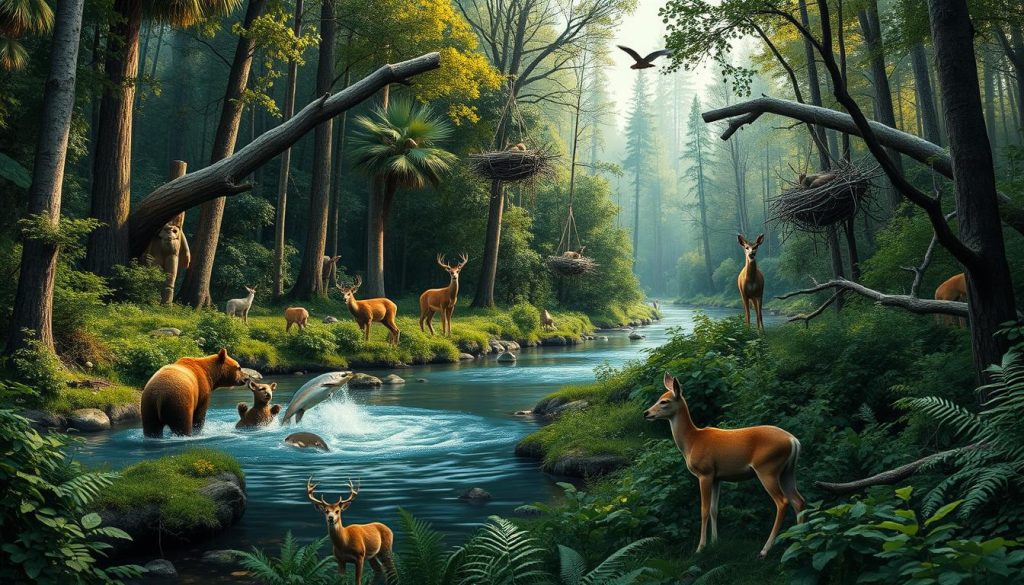
Animal Communication: A Language of Its Own
The natural world is full of sounds, gestures, and signals. Animals talk to each other in many ways. From birds’ vocalizations to primates’ gestures, and scent signals of many, it’s all fascinating.
Scientists in ethology study animal behavior. They spend hours figuring out animal languages. By watching and analyzing, they learn a lot about nature.
Decoding Vocalizations, Gestures, and Signals
Animal sounds like birds’ chirps and predators’ growls have many uses. They mark territory, warn of danger, attract mates, and help with social interactions. Studying these sounds helps us understand animal motivations and social lives.
Animal gestures and body language are also key in communication. An animal’s posture, ear position, and movement intensity tell a lot. By understanding these signals, researchers learn about an animal’s feelings, status, and plans.
Many animals use scent-based signals like pheromones. These chemical cues help mark territory, attract mates, and signal distress or aggression. By studying these signals, scientists uncover secrets of animal social and reproductive behaviors.
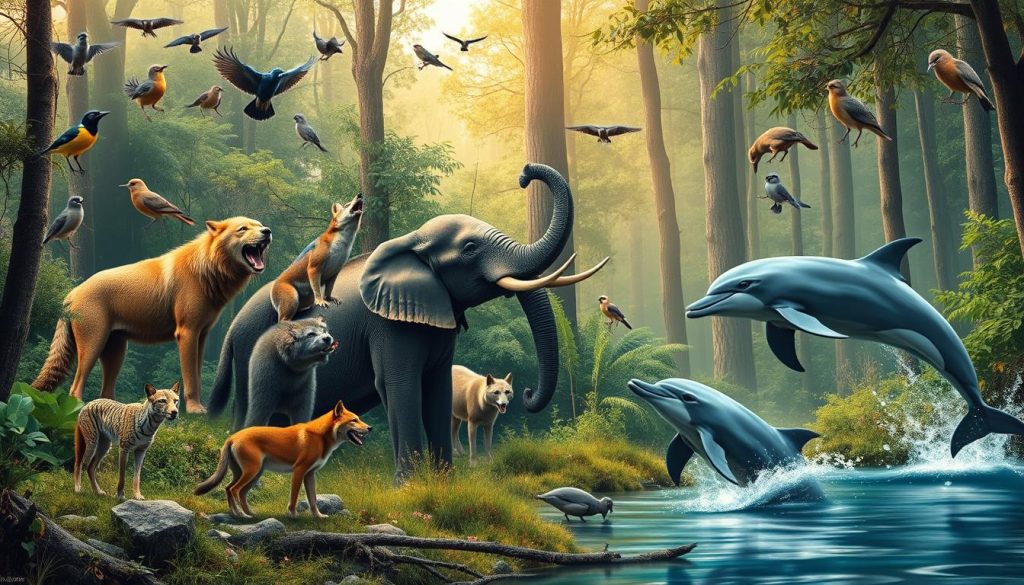
Studying animal communication helps us understand the natural world better. By decoding vocalizations, gestures, and signals, we appreciate the diversity of life around us.
Social Dynamics in the Animal Kingdom
The animal kingdom is full of fascinating social structures and relationships. These social dynamics are key to many species’ survival. They help with hunting together and defending territory. Exploring animal social behavior and group dynamics offers insights into these creatures’ lives.
Many animals have complex ways to communicate. They use sounds, gestures, and signals to share info and show who’s in charge. By studying these animal social behavior patterns, scientists learn a lot about group dynamics.
Cooperative hunting is a great example of social dynamics. Predators like wolves and lions hunt together. This teamwork boosts their success and strengthens their group bonds.
Defending territory is also important in the animal kingdom. Animals use scents, sounds, and displays to mark their areas. This helps keep resources balanced and ensures the group’s survival.
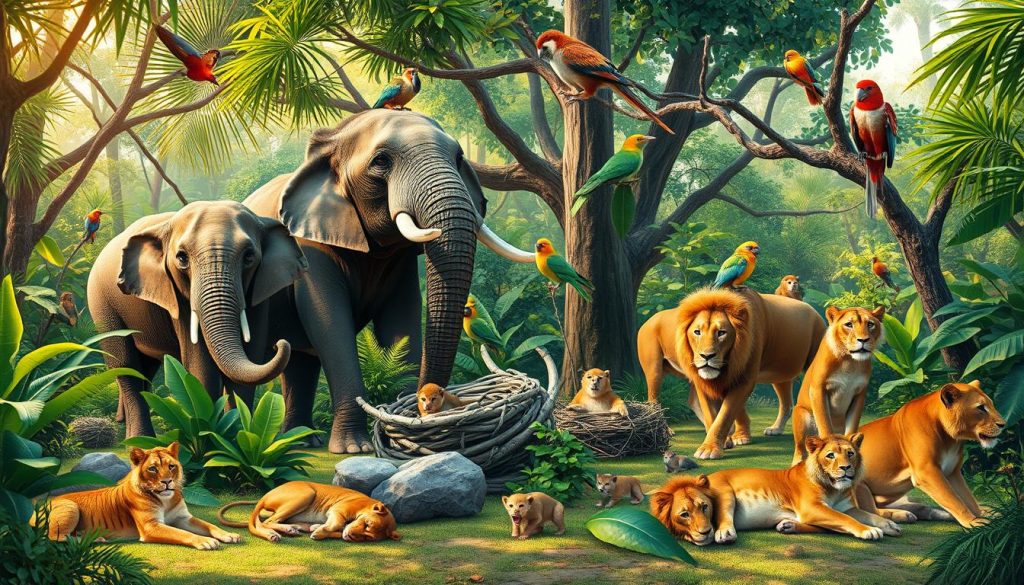
Studying social dynamics in animals helps us understand their ethology. This knowledge is not just interesting. It also helps in conservation and deepens our love for nature.
 The carbon cycle: How it works and its importance for life
Animal behavior: Unraveling the Mysteries
From Foraging to Mating Rituals
The world of animal behavior is full of fascinating activities. From the clever foraging of hungry predators to the stunning mating rituals in the wild. Researchers in ethology explore these mysteries, helping us understand the complex ways animals make decisions and adapt.
Foraging is key for animals to find food and survive. Whether it’s wolves chasing prey or ants searching the forest, their strategies show their intelligence and ability to adapt. These foraging behaviors are amazing.
The mating rituals in nature are also captivating. From birds’ courtship dances to mammals’ territorial displays, these show the intense competition and cooperation in reproduction. By studying these rituals, researchers uncover the evolutionary forces behind these behaviors.
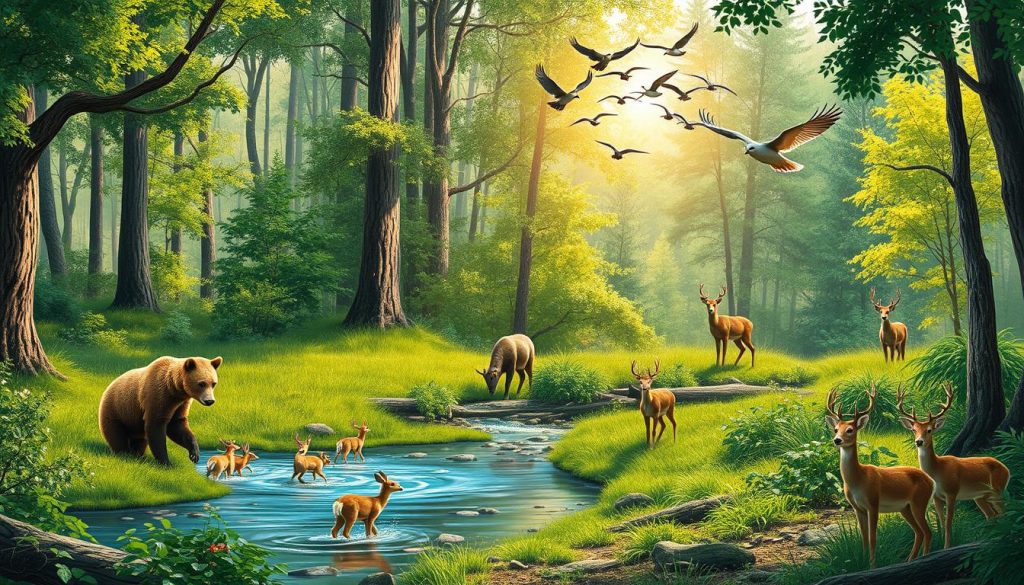
The study of animal behavior is complex and always changing. It shows the amazing adaptations and decision-making of animals in their environments. Through observation, experiments, and analysis, researchers keep uncovering the wonders of the natural world. This helps us appreciate the complex and fascinating creatures we share our planet with.
Adaptation: The Key to Survival
In the natural world, adaptation is key for animals to thrive and survive. Animal adaptation helps species evolve traits that fit their environment. This process is driven by natural selection, shaping species over time.
The polar bear’s thick fur keeps it warm in the Arctic. The chameleon can change color to hide. These are just a few examples of adaptations in the animal kingdom. Ethology, the study of animal behavior, helps us understand these adaptations.
Animals have unique behaviors like migrating or hunting. These behaviors are linked to their evolutionary adaptations. By studying these survival mechanisms, we appreciate the clever ways animals thrive.
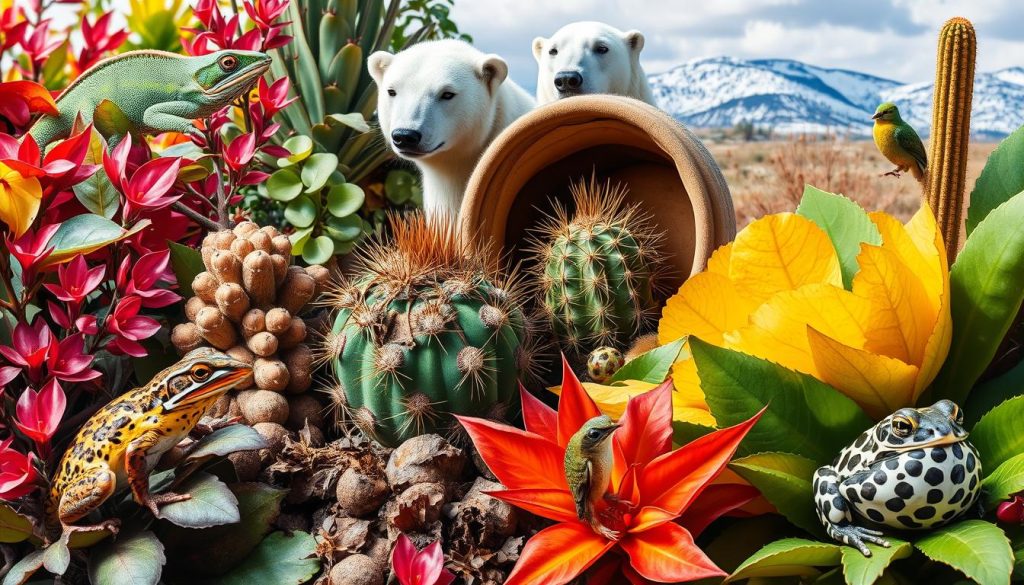
From tiny insects to huge mammals, animals show incredible adaptability. As we learn more about animal behavior, we discover how species evolve to thrive in changing environments.
Learning and Cognition in Animals
Many animals have amazing learning and thinking skills. They can learn new things, solve problems, and make complex choices. This section explores the world of animal learning, thinking, and intelligence. We’ll look at how different animals are smart in their own ways.
Exploring Intelligence Across Species
Recent studies have shown that many animals are smarter than we thought. Crows can solve problems, octopuses navigate, and elephants are socially smart. These examples show that animal intelligence is widespread.
Animal behavior studies, or ethology, have given us many interesting insights. They’ve found out how animals learn, adapt, and interact with their world. From cats learning words to zebrafish exploring, animals are full of surprises.
| Species | Cognitive Abilities | Noteworthy Findings |
|---|---|---|
| Zebrafish | Curiosity, Exploration | Researchers showed zebrafish 30 novel objects and analyzed their interactions, revealing their innate curiosity and propensity for exploration. |
| Octopus | Memory, Spatial Navigation | A 2022 review study reported that octopuses exhibit memory and form mental maps for navigational purposes, showcasing their impressive cognitive skills. |
| Elephants | Social Intelligence, Empathy | Scientists in India studied five instances of an entire elephant herd participating in burying a deceased young elephant, demonstrating their social intelligence and emotional capacity. |
As we learn more about animal learning and thinking, our understanding grows. The recognition of animal sentience in law and the focus on animal intelligence research are changing how we see the natural world.
The Role of Evolutionary Psychology
Evolutionary psychology helps us understand animal behavior shaped by natural selection. It looks at how fitness, mating strategies, and kin selection influence animal actions. This knowledge also helps us understand human behavior.
The core of evolutionary psychology is fitness. It’s about an animal’s ability to survive and reproduce. Animals have developed many behaviors to increase their fitness. These include foraging and mating rituals, shaped by their evolutionary history.
Another key area is mating strategies. Animals have unique ways to find mates and ensure their offspring’s survival. By studying these strategies, we learn about the evolutionary forces behind their social behaviors and communication.
- Kin selection is also crucial. It’s when animals act altruistically towards their relatives. This is seen in social animals like ants and groups defending each other.
- Applying evolutionary psychology to animal behavior helps us understand the natural world and humans too. It shows how our behaviors are connected to our animal ancestors.
| Evolutionary Psychology Concept | Relevance to Animal Behavior |
|---|---|
| Fitness | Behaviors that enhance an individual’s ability to survive and reproduce |
| Mating Strategies | Approaches to finding a mate, securing resources, and ensuring offspring survival |
| Kin Selection | Altruistic behaviors towards genetic relatives, observed in social animals |
Studying evolutionary psychology in animal behavior reveals a deeper understanding of nature. It shows how biology, environment, and behavior interact. This knowledge helps in conservation, animal welfare, and human development.
Observing Animal Behavior in the Wild
Studying animals in their natural habitats is key to understanding their actions and how they adapt. Researchers use many methods to observe and document animal behavior. They aim to capture the details of their lives while being ethical.
Field Research and Ethical Considerations
Camera traps are a main tool for observing animal behavior. These cameras capture images of animals without interrupting their natural behavior. Behavioral sampling is another method that involves watching and recording specific behaviors.
Scientists studying animal behavior must also think about ethics. They make sure the animals are not harmed or stressed. This includes keeping a safe distance and getting the right permits.
By using new ways to observe and being careful with ethics, researchers learn a lot about animals. This knowledge helps in saving species and understanding the world better.
Watching animals in their natural habitats is crucial for understanding their behavior. Researchers use tools like camera traps and behavioral sampling. They do this while following strict ethical rules. This helps scientists learn about the animal kingdom and helps protect these amazing creatures.
Nurture vs. Nature: The Ongoing Debate
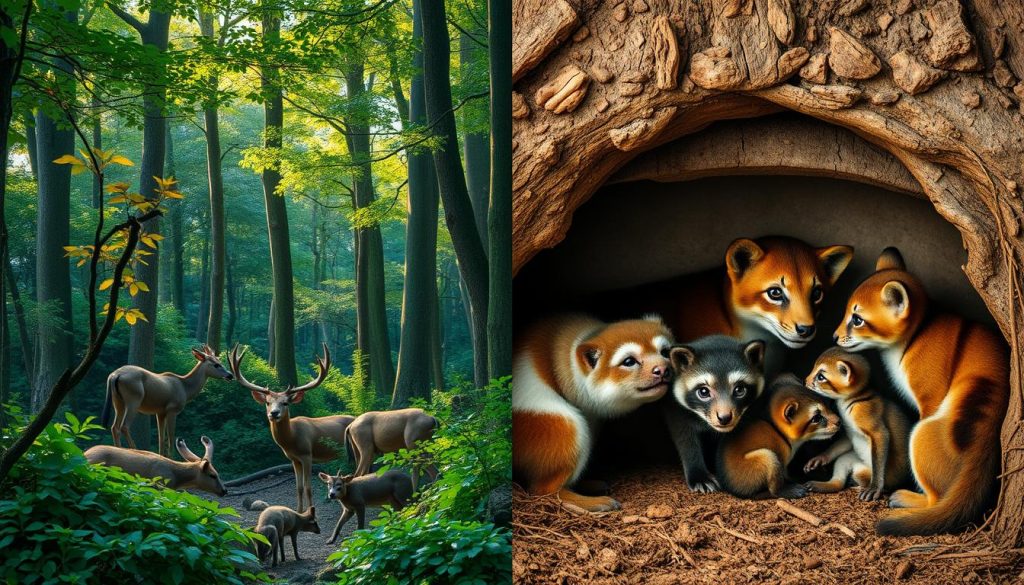
The debate over nature (genetics) and nurture (environment) in animal behavior is fascinating. It looks at how an animal’s genes and life experiences affect its behavior. This is key to understanding what shapes animal behavior.
Those who believe in nature say an animal’s behavior comes from its genes. They think things like bird migration and hunting are passed down through generations. On the other hand, the nurture side thinks the environment and upbringing are more important.
 Biomes of the planet: Global characteristics and ecosystems
| Nature | Nurture |
|---|---|
| Genetic factors | Environmental influences |
| Innate instincts | Learned behaviors |
| Evolutionary adaptation | Early life experiences |
The debate between nature and nurture has helped us understand animal behavior better. Scientists keep studying how these factors work together. This helps us see the amazing ways animals adapt and survive.
The nature vs. nurture debate will keep being important in ethology. By looking closely at this debate, we learn more about animal behavior. It shows us how evolution and environment shape the animal world.
Remarkable Cases of Animal Intelligence
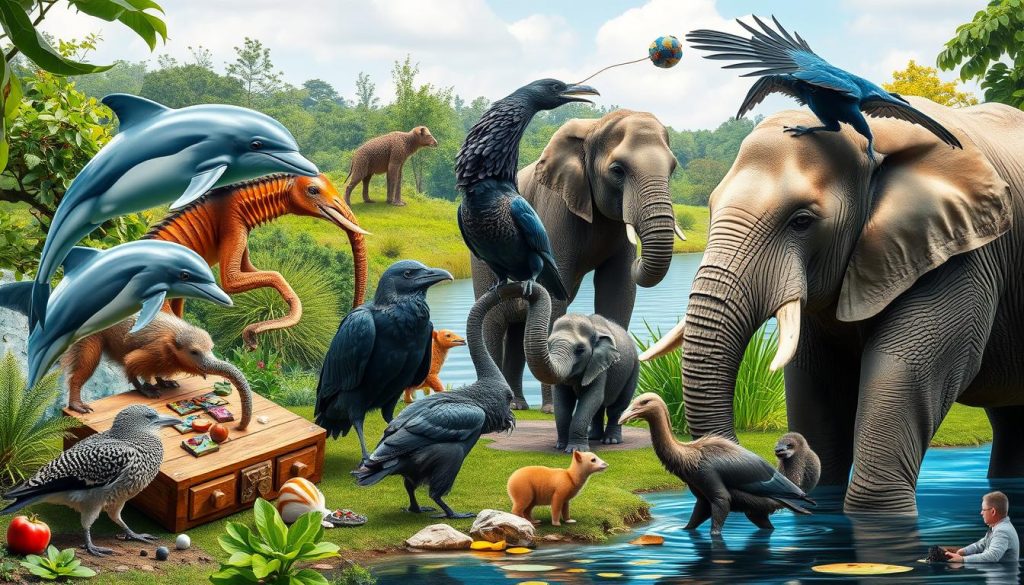
The animal kingdom is full of amazing examples of smart behavior. From chimpanzees using tools to pigeons navigating, animal intelligence is fascinating. It shows us how smart animals can be, thanks to ethology research.
Chimpanzees, our closest relatives, are known for their tool use. They make sticks to catch termites and leaves to soak up water. Their complex social lives and communication skills show their animal intelligence.
Pigeons are often seen as simple birds, but they’re actually very smart. They can remember hundreds of images and navigate long distances. This proves their cognitive abilities in the wild.
Whales and dolphins have complex ways of communicating. They use sounds and gestures to talk to each other. This shows their animal intelligence is as good as many land animals.
These examples highlight the importance of studying animal intelligence. By learning about different species’ smarts, we understand evolution better. It shows how diverse intelligence can be in nature.
The Importance of Animal Behavior Studies
Studying animal behavior, or ethology, is key to understanding our world. It helps us know more about animals and how to protect them. It also teaches us about ourselves and how we make decisions.
Implications for Conservation and Human Understanding
Animal behavior studies give us clues for saving endangered species. By watching how animals live and react to dangers, we can find better ways to protect them. This knowledge helps us make choices that work for both animals and people.
Also, studying animal behavior helps us understand how humans evolved. Seeing how animals talk, work together, and solve problems can teach us about our own social and thinking abilities. These findings can change how we study psychology, sociology, and anthropology.
| Statistic | Findings |
|---|---|
| Prevalence of autism spectrum disorders (ASD) in Lebanon | As of 2016, the prevalence of ASD was estimated to be 1 in 66 children in Beirut and Mount regions, reflecting a specific regional occurrence rate. |
| Prevalence of ASD in the United States | The estimated prevalence of ASD has risen to affect 1 in 54 children who are 8 years old, showcasing a notable occurrence rate in a specific demographic. |
| Gut microbiome studies related to ASD | Contradictory results in gut microbiome studies indicate varying statistical outcomes in different populations and study samples. |
| Gut microbial composition in ASD individuals in Lebanon | A significantly higher relative abundance of Proteobacteria was observed in the ASD group compared to the control group, indicating specific microbial variations. |
| Firmicutes/Proteobacteria (F/P) ratio in different groups | The F/P ratio was notably higher in the control and sibling groups as compared to the ASD group, reflecting distinct microbial compositions among different groups. |
Animal behavior studies are vital for understanding our world and ourselves. By exploring animal communication, social behavior, and thinking, we gain insights. These insights help us protect the environment and understand our own evolution.
Captive vs. Wild Animal Behavior
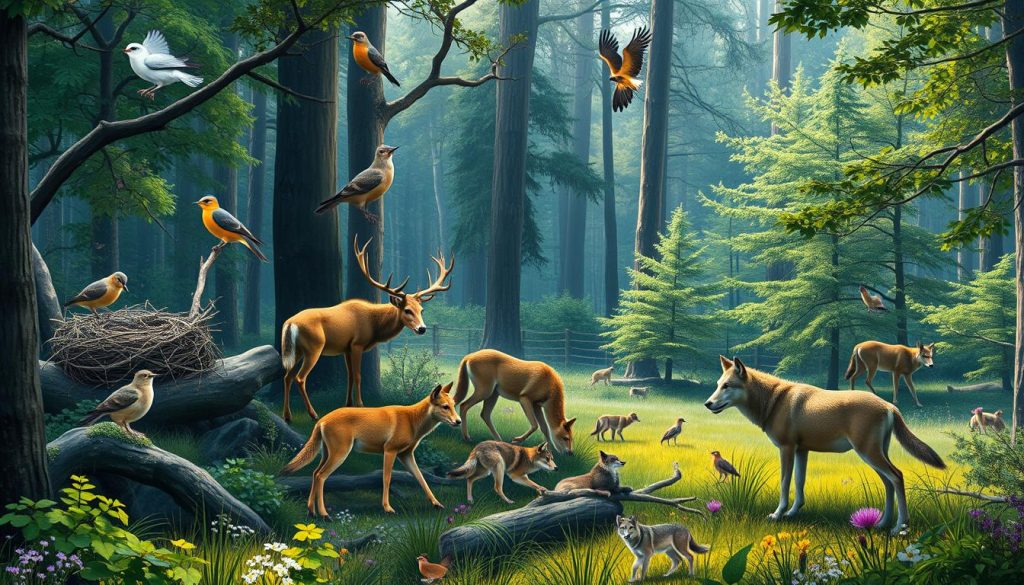
Understanding animal behavior is key, and knowing the difference between captive and wild settings is important. Observing captive animal behavior can give us insights, but it’s different from their natural habitats. This section looks at the differences in studying captive animal behavior and its impact on understanding wild animal behavior and ethology.
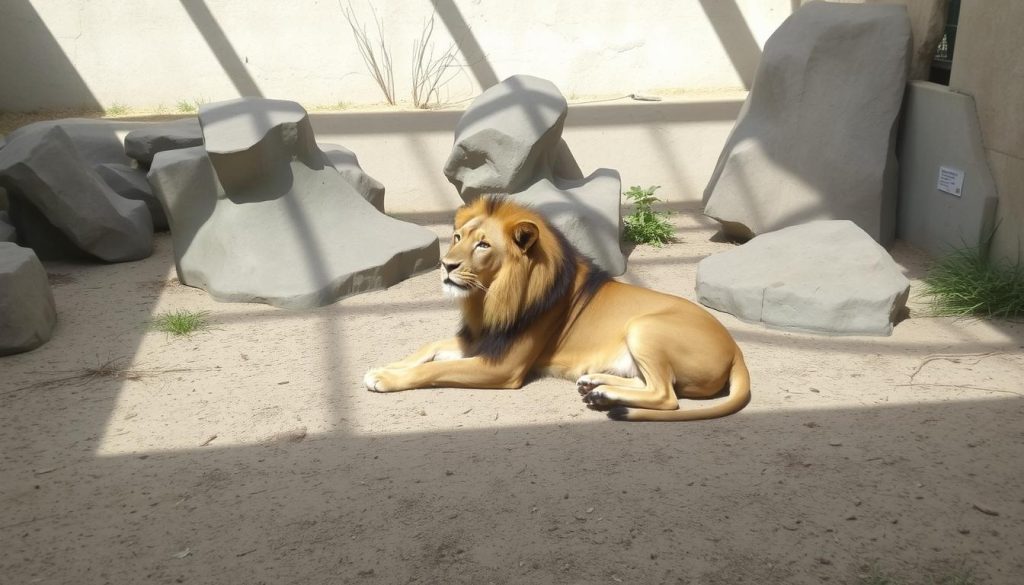
Studying captive animals has its challenges. Their artificial environment can change their natural behaviors. Limited space, lack of natural stimuli, and human caretakers can affect their well-being. This means their behaviors might not be the same as in the wild. Researchers need to think about these factors when studying captive animals and their animal welfare.
However, captive environments also offer chances for detailed observation and experiments. These can help us learn more about animal thinking, communication, and social life. By creating enrichment programs and mimicking natural habitats, researchers can help animals behave more naturally. This can give us important insights into their species.
| Captive Animal Behavior | Wild Animal Behavior |
|---|---|
| Influenced by artificial environment | Reflects natural habitat and social dynamics |
| Opportunity for controlled observation and experimentation | Provides a more authentic representation of species-specific behaviors |
| Potential challenges in maintaining animal welfare | Offers a comprehensive understanding of ethology |
By understanding both captive and wild animal behavior, researchers can get a better picture of the natural world. This approach helps us learn more about wild animal behavior and improve the care of captive animal behavior. It’s a way to protect and conserve animal behavior while also improving their well-being.
The Future of Animal Behavior Research
Animal behavior research, or ethology, is growing fast. New discoveries and tech are changing how we study animals. This lets us understand the natural world better.
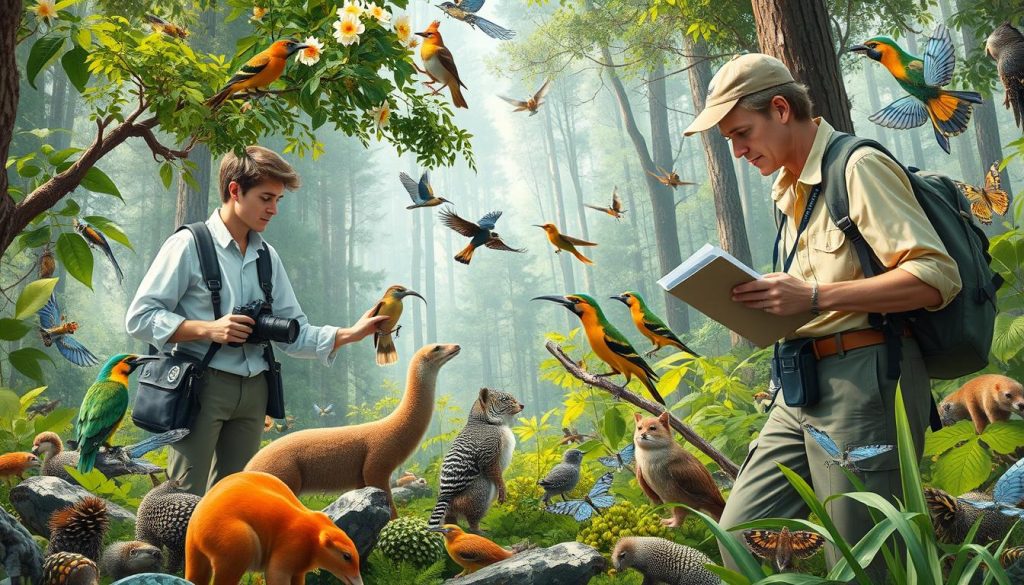
Advanced tracking and monitoring systems are key. Sophisticated GPS, high-resolution cameras, and mini sensors help gather detailed data. This data shows how animals move, communicate, and live together.
There’s also a big push for working together across different fields. Scientists from conservation, environmental science, and computer science are teaming up. This mix of ideas leads to new discoveries and solutions.
But, there are still challenges. Ensuring animal welfare in research is crucial. Scientists are always looking for better ways to study animals without harming them.
The future of animal behavior research is bright. It could lead to new insights into animal behaviors and adaptations. With new tech and teamwork, ethology is set to make big strides in understanding and protecting animals.
| Key Trends in the Future of Animal Behavior Research | Impact |
|---|---|
| Technological Advancements | Improved data gathering, tracking, and analysis capabilities |
| Interdisciplinary Collaboration | Innovative solutions and cross-pollination of ideas |
| Ethical Considerations | Responsible and humane research practices |
| Conservation Implications | Informing strategies for the protection of animal populations |
Connecting with Nature Through Observation
Studying animal behavior can deeply connect us to nature. By watching how different species behave, we learn to appreciate the amazing variety of life around us. This helps us see the world in a new light.
Exploring parks, backyards, or wilderness areas can be magical. By paying close attention to animal behaviors, we discover a world full of wonder. This way of observing not only broadens our scientific knowledge but also strengthens our bond with other living beings.
Enhancing Our Appreciation for Wildlife
Observing animal behavior helps us understand the importance of our ecosystems. We see how each species contributes to nature’s balance. For example, squirrels and birds play key roles in their environments.
 Soil ecology: Life beneath our feet
By witnessing these behaviors, we gain a deeper respect for nature. This inspires us to care more for our planet. It encourages us to be better stewards of the environment.