

Dorothy Hodgkin and the Power of X-Ray Crystallography

Dorothy Hodgkin xray crystallography
Dorothy Hodgkin, a renowned British chemist and Nobel laureate, revolutionized the world of molecular biology with her pioneering work in the field of x-ray crystallography.
Through her groundbreaking research, she unlocked the structures of key biochemical substances, providing vital insights that have had a profound impact on medicine, biology, and chemistry. Hodgkin’s contributions not only advanced the scientific community but also paved the way for future discoveries that continue to shape modern science.
Early Life and Education
Dorothy Mary Crowfoot was born on May 12, 1910, in Cairo, Egypt, where her father worked as an archaeologist. She moved to England with her family at the age of five. As a child, Hodgkin was fascinated by science and went on to study chemistry at the University of Oxford, where she earned a degree in 1932. She later completed her postgraduate research at Cambridge University, where her interest in x-ray crystallography began to take root.
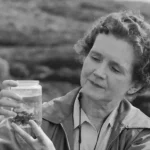 Rachel Carson: The Scientist Who Sparked Environmental Awareness
 The Development of X-Ray Crystallography
X-ray crystallography is a technique used to determine the atomic and molecular structure of a crystal. By bombarding a crystal with X-rays, scientists can observe how the rays scatter, revealing detailed information about the structure of the material. This method was first developed in the early 20th century and quickly became an invaluable tool in structural chemistry.
Hodgkin, along with other early pioneers in the field, was instrumental in refining this technique. Her ability to interpret the patterns formed when X-rays passed through crystals allowed her to determine the structure of complex molecules that were previously thought to be too intricate to analyze.
Breakthrough Discoveries
One of Dorothy Hodgkin’s most significant achievements was the determination of the structure of penicillin. In 1945, she became the first person to solve the molecular structure of penicillin using x-ray crystallography, providing critical insight into how this antibiotic worked. Her work contributed greatly to the development of synthetic antibiotics, which have saved millions of lives worldwide.
 Stephen Hawking’s Theories About the Universe
 In 1956, Hodgkin made another breakthrough by determining the structure of vitamin B12, an essential compound for human health. This discovery was of enormous importance, as it advanced our understanding of how this vitamin functions at the molecular level. For her work on vitamin B12, she was awarded the Nobel Prize in Chemistry in 1964, making her the third woman to receive the Nobel Prize in Chemistry.
The Legacy of Dorothy Hodgkin
Dorothy Hodgkin’s legacy extends far beyond her groundbreaking discoveries. Her work laid the foundation for modern pharmaceutical research and structural biology. Thanks to Hodgkin’s innovations in x-ray crystallography, scientists today are able to analyze the structures of complex biological molecules, aiding in the development of new drugs and therapies.
In addition to her scientific achievements, Hodgkin was a strong advocate for women in science. She mentored countless young scientists and played an active role in promoting the inclusion of women in the scientific community. Her dedication to both her research and her colleagues has made her an inspiration to generations of scientists.
 Carl Sagan: Exploring the Cosmos and Beyond
 Key Contributions and Achievements
- Pioneering the use of x-ray crystallography to determine the structures of key biochemical compounds.
- Penicillin Structure – First to solve the molecular structure of penicillin, advancing the field of antibiotics.
- Vitamin B12 Structure – Groundbreaking work in determining the structure of vitamin B12, earning her the Nobel Prize in Chemistry in 1964.
- Mentorship and Advocacy – Active in promoting women in science and mentoring young scientists.
Conclusion
Dorothy Hodgkin’s contributions to science are immeasurable, and her work with x-ray crystallography remains one of the most important advancements in the field of molecular biology. Her discoveries not only advanced our understanding of crucial biological compounds but also opened new pathways for medical research and drug development. As one of the most influential scientists of the 20th century, Dorothy Hodgkin’s legacy will continue to inspire future generations of scientists and innovators for years to come.


