
James Clerk Maxwell and the Electromagnetic Theory

James Maxwell electromagnetic theory
James Clerk Maxwell was a Scottish physicist and mathematician whose groundbreaking work in the 19th century laid the foundation for modern physics. Among his many contributions, Maxwell is best known for formulating the Electromagnetic Theory, which unified the fields of electricity and magnetism. His work on this theory led to the understanding that light is an electromagnetic wave, a discovery that revolutionized physics and profoundly impacted fields from engineering to astronomy.
Early Life and Education
Born in 1831 in Edinburgh, Scotland, James Clerk Maxwell displayed an early fascination with science and mathematics. Maxwell attended the University of Edinburgh before moving to the University of Cambridge, where he furthered his studies in physics. His profound curiosity and intellectual rigor allowed him to excel, eventually leading him to publish his first scientific paper at the age of just 14.
The Path to Electromagnetic Theory
Maxwell’s journey towards formulating the electromagnetic theory began with his deep interest in understanding the nature of light. Building upon the work of Michael Faraday, who introduced the concept of an electric field, Maxwell sought to mathematically describe how electric and magnetic fields interact. He recognized that these forces were not separate entities but were interconnected phenomena.
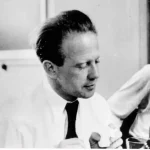 Werner Heisenberg: The Uncertainty Principle Explained
Maxwell’s Equations: The Core of Electromagnetic Theory
The heart of Maxwell’s electromagnetic theory lies in a set of four equations, now famously known as Maxwell’s Equations. These equations describe how electric and magnetic fields are generated and altered by each other and by charges and currents. They are:
- Gauss’s Law for Electricity:
∇ • E = ρ / ε₀– This describes the relationship between electric charges and electric fields. - Gauss’s Law for Magnetism:
∇ • B = 0– This implies that magnetic monopoles do not exist, and magnetic field lines are continuous. - Faraday’s Law of Induction:
∇ × E = -∂B / ∂t– This law shows how a changing magnetic field creates an electric field. - Ampère’s Law (with Maxwell’s correction):
∇ × B = μ₀ (J + ε₀ ∂E / ∂t)– This reveals how electric currents and changing electric fields produce magnetic fields.
Connecting Light with Electromagnetic Waves
Through these equations, Maxwell made an extraordinary discovery: light itself is an electromagnetic wave. By combining the equations, Maxwell found that electromagnetic waves travel at the speed of light. This realization provided a unified theory that explained both visible light and invisible electromagnetic radiation, such as radio waves and X-rays, all as manifestations of the same underlying electromagnetic field.
Impact on Modern Science and Technology
The Birth of Radio Waves
Maxwell’s prediction of electromagnetic waves led to experiments by later scientists, notably Heinrich Hertz, who confirmed the existence of radio waves. This validation laid the foundation for modern wireless communication, including radio, television, and later, Wi-Fi and cellular networks. Today’s communication systems heavily rely on the principles of electromagnetic theory.
 The North Star: Our Celestial Guide
Advances in Optics and Quantum Physics
Maxwell’s work also deeply influenced the study of light. The concept of electromagnetic waves became a fundamental part of optics and further advanced the understanding of light in quantum physics. Einstein’s later development of the theory of relativity was partially motivated by Maxwell’s findings, as Einstein sought to explore how the laws of electromagnetism applied to different reference frames.
Legacy and Recognition
Despite his revolutionary contributions, Maxwell’s work was not fully appreciated during his lifetime. Today, however, he is regarded as one of the greatest scientists in history, often placed alongside Isaac Newton and Albert Einstein. His theories are not only foundational to physics but also to many fields that define modern technology.
Beyond Physics: The Influence of Maxwell’s Theory
In addition to shaping modern physics, Maxwell’s contributions have had far-reaching implications in fields as diverse as engineering, astronomy, and even biological sciences. The practical applications of his theories continue to expand, proving that his legacy is as enduring as it is influential.
 Anders Celsius and the Creation of the Celsius Temperature Scale
Final Reflections on Maxwell’s Impact
James Clerk Maxwell’s work on electromagnetic theory is a testament to the power of human curiosity and mathematical insight. His contributions have not only expanded our understanding of the universe but also provided the tools and principles that continue to shape the modern world. Maxwell’s equations remain fundamental, embodying the elegance and unity of nature’s forces and inspiring generations of scientists and engineers.


