

Auroras: Earth’s Magical Light Show in the Sky

One of Earth’s most captivating phenomena, auroras—also known as the Northern and Southern Lights—light up the sky with vibrant colors and intricate shapes. These spectacular light displays are caused by complex interactions between the solar wind, Earth’s magnetic field, and our atmosphere.
But what exactly creates these mesmerizing lights, and why do they only occur at certain locations on Earth? In this article, we’ll explore the science behind auroras, their connection to the magnetic field, and fascinating facts about these dazzling lights.
What Are Auroras and How Are They Formed?
Auroras are natural light displays that occur predominantly near the polar regions. They are created when charged particles from the solar wind collide with gases in Earth’s upper atmosphere. As these particles interact with gases like oxygen and nitrogen, they produce colors ranging from green to pink, purple, red, and blue. But what triggers these particles to reach our atmosphere, and why does the phenomenon concentrate at the poles? The answer lies in Earth’s magnetic field.
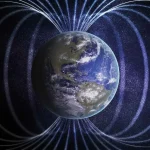 Polar Shift Phenomena: How Earth’s Magnetic Poles Flip
 The Role of Earth’s Magnetic Field in Creating Auroras
Earth is surrounded by a magnetic field that acts as a protective shield, deflecting most of the solar wind particles. However, near the polar regions, the magnetic field lines dip closer to the Earth’s surface. When charged particles from the Sun encounter Earth’s magnetosphere, they follow these magnetic field lines toward the poles, creating an oval-shaped region where auroras are likely to appear.
Upon reaching the upper atmosphere, the charged particles collide with atmospheric gases, transferring energy and causing them to emit light. This is similar to the principle behind neon lights, where electrical energy excites gas molecules, causing them to glow. The primary colors seen in auroras are determined by the type of gas molecules involved:
- Green: Caused by oxygen molecules at altitudes around 60 miles (96 kilometers).
- Red: Caused by oxygen at higher altitudes, above 150 miles (240 kilometers).
- Purple and blue: Caused by nitrogen molecules when they interact with solar particles at various altitudes.
Why Auroras Only Appear Near the Poles
The polar regions are where auroras are most frequently visible because of how the magnetic field directs solar particles toward these areas. Known as the “auroral oval,” this zone surrounds Earth’s magnetic poles and shifts depending on solar activity. The more intense the solar wind, the more likely auroras are to appear further from the poles, allowing for occasional sightings in regions like northern Europe or even parts of North America.
 Oldest Life Forms on Earth: Tracing the Origins of Life
 The Science Behind the Colors and Patterns
The breathtaking swirls, curtains, and arcs seen in auroras are a direct result of particle dynamics and Earth’s magnetic field structure. When the solar wind strengthens, the auroral display often becomes more dynamic, with shapes that evolve quickly in response to the influx of solar energy. Additionally, variations in altitude and gas type influence color, while magnetic disturbances create rippling waves and spirals.
Understanding the Mathematics of Auroras
The energy involved in auroral displays can be represented in terms of particle collision energy, which depends on both the speed of the particles in the solar wind and the density of Earth’s atmosphere. The typical energy of these particles is about 1 keV (1,000 electron volts), which is enough to excite atmospheric molecules. Additionally, magnetic field strength is measured in units of microteslas (μT), typically between 25 μT to 65 μT near the polar regions. These measurements help scientists understand how auroras are influenced by solar and magnetic activity.
Why Solar Storms Intensify Auroras
During periods of heightened solar activity, such as solar flares or coronal mass ejections, more charged particles are released by the Sun. When these particles reach Earth, they increase the frequency and intensity of auroras, sometimes making them visible in latitudes where they’re not usually seen. The enhanced auroras resulting from solar storms are often more colorful and appear in complex, rapidly shifting patterns.
 The Mysterious Underwater Caves of Earth
 Fascinating Facts About Auroras
- Auroras occur on other planets: Jupiter and Saturn, both of which have strong magnetic fields, also experience auroras, though their colors and intensity differ due to different atmospheric compositions.
- Auroras were once considered omens: In ancient times, auroras were often seen as supernatural phenomena or omens. Norse mythology, for instance, attributed them to the reflections of Valkyrie armor.
- The southern counterpart is the “Aurora Australis”: While most people are familiar with the Northern Lights, auroras also appear in the Southern Hemisphere, known as the Aurora Australis or the Southern Lights.
How to See Auroras
To witness auroras, it’s best to travel to areas near the magnetic poles, such as northern Canada, Alaska, Norway, or Iceland for the Northern Lights. For the Southern Lights, regions like New Zealand and Antarctica provide the best views. Observers should choose dark, clear nights and monitor solar activity forecasts for higher chances of a sighting.
Conclusion
Auroras remain one of Earth’s most enchanting natural wonders. Created by the interaction between the solar wind and Earth’s magnetic field, these stunning light shows remind us of the dynamic connection between our planet and the Sun. From brilliant greens to fiery reds, auroras continue to captivate onlookers and serve as a powerful example of the beauty hidden in scientific phenomena.


