The structure of DNA: The code of life

DNA, or deoxyribonucleic acid, is the key genetic material. It carries the instructions for life’s development and function. It’s the code of life, holding the vital information for cells to grow and work properly.
The DNA structure is a double helix. It’s made of two strands of nucleotides that twist together. This design lets DNA store and share genetic information well. Knowing how DNA is structured is key for progress in genetics, biotechnology, and molecular biology.
Introduction to DNA
DNA, or deoxyribonucleic acid, is key to life. It stores and passes on genetic information in all living things. Found in the cell’s nucleus, it guides the creation of proteins, life’s building blocks.
DNA is vital for heredity. It carries genetic information from parents to their children. This ensures that genetic traits are passed down through generations.
The Significance of DNA in Life
The discovery of DNA’s double-helix structure by James Watson and Francis Crick in 1953 was a major breakthrough. It changed how we understand genetic information storage and expression. This discovery opened new doors in molecular biology, revealing life’s fundamental nature.
Historical Discoveries Leading to DNA Understanding
Our understanding of DNA has grown over time. In the late 19th century, Friedrich Miescher found “nuclein” in white blood cells. Later, Phoebus Levene described nucleic acids’ basic structure.
In the 1940s, Oswald Avery, Colin MacLeod, and Maclyn McCarty showed DNA’s role in genetic transformation. Their work led to Watson and Crick’s 1953 discovery. They revealed DNA’s double-helix structure and its role in genetic information storage and replication.
The Double Helix Structure
The double helix structure of DNA is key for storing and passing on genetic information. It’s made of two strands of nucleotides that twist together, forming a spiral. These strands are connected by hydrogen bonds between nitrogenous bases, with A pairing with T and G pairing with C.
This pairing keeps the DNA stable and intact. The double helix also makes DNA replication efficient during cell division. The two strands can be split and used to make new, identical DNA molecules. This ensures genetic information is passed on accurately, a crucial part of life.
| Key Features of the DNA Double Helix | Significance |
|---|---|
| Two strands of nucleotides wound around each other | Provides a compact and stable structure for storing genetic information |
| Complementary base pairing (A-T, G-C) | Ensures the integrity and accuracy of the genetic code |
| Spiral shape | Allows for efficient replication and packaging of DNA within the cell |
The double helix structure of DNA is a remarkable adaptation. It has enabled life to thrive on our planet. This unique molecular structure has been the foundation for the incredible diversity of life we see today.
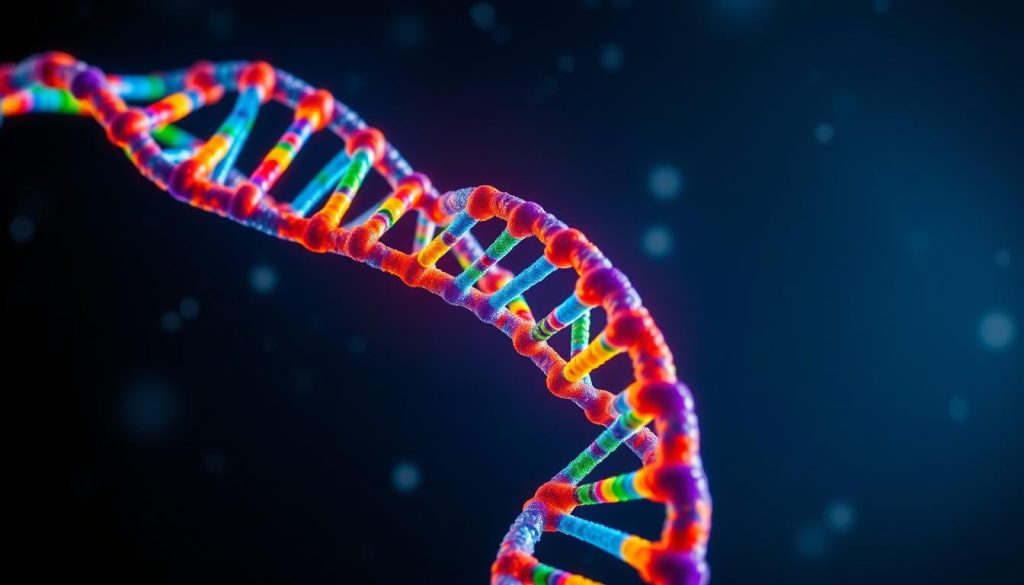
Nucleic Acids: The Building Blocks
Nucleic acids, like DNA and RNA, are made up of smaller parts called nucleotides. Each nucleotide has a nitrogenous base, a sugar, and a phosphate group. DNA has deoxyribose sugar, while RNA has ribose. The main difference is that ribose has a hydroxyl group, but deoxyribose does not.
This difference affects how DNA and RNA work in cells.
Deoxyribose and Ribose
The sugars in DNA and RNA are key to their structure and function. Deoxyribose in DNA is more stable because it lacks a hydroxyl group. This makes DNA’s double-helix structure more stable, helping it store and pass on genetic information accurately.
Nitrogenous Bases
The nitrogenous bases carry the information in nucleic acids. In DNA, there are four bases: adenine (A), thymine (T), guanine (G), and cytosine (C). These bases pair up in a specific way, with A always with T and G always with C. This pairing is vital for passing on genetic information correctly.
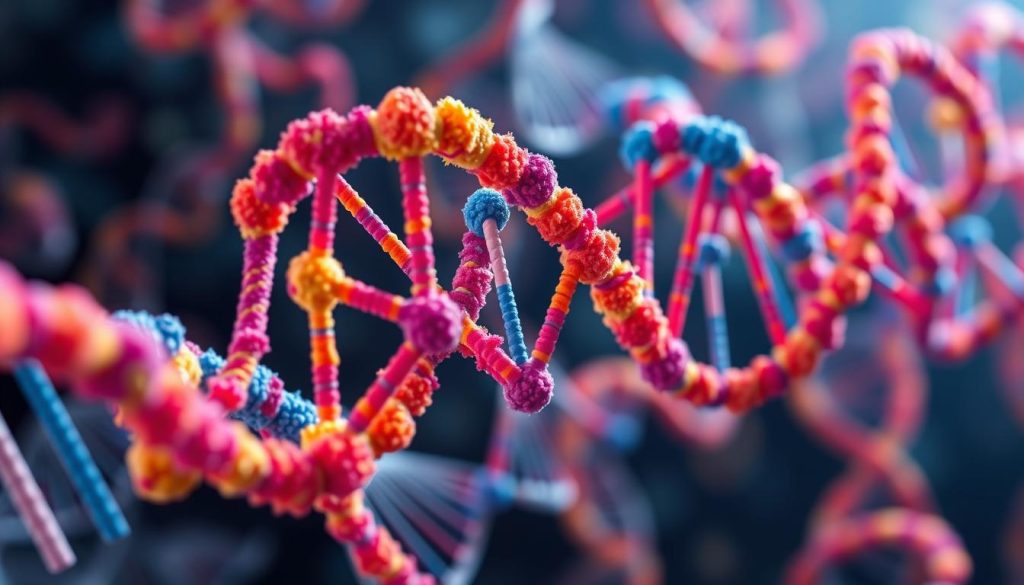
The pairing of nitrogenous bases and the sugar-phosphate backbone create DNA’s double-helix structure. This structure is crucial for storing and passing on genetic information in living things.
DNA and its structure
The structure of DNA is made of two strands of nucleotides that twist together, forming a double helix. Each nucleotide has a deoxyribose sugar, a phosphate group, and one of four nitrogenous bases: adenine, thymine, guanine, or cytosine. The strands are connected by hydrogen bonds between complementary base pairs (A-T and G-C). This design lets DNA store and share genetic information efficiently, holding the entire genetic code in each cell’s nucleus.
The double helix of DNA is a remarkable natural design. It efficiently stores and shares genetic information. The base pairing and hydrogen bonds between strands make a stable, dynamic structure. This structure is key to life’s fundamental processes, like replication and growth.
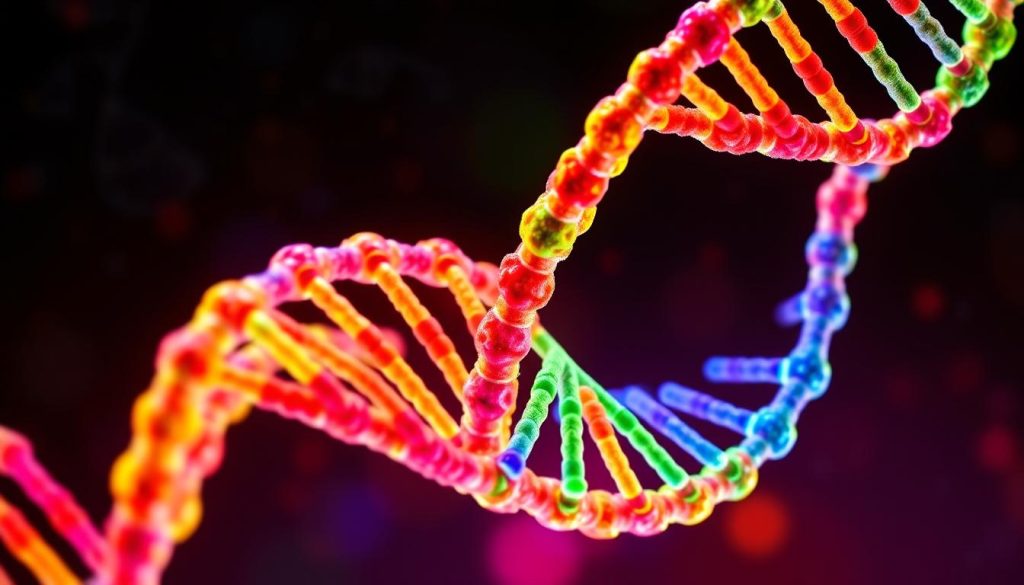
The four nitrogenous bases – adenine, thymine, guanine, and cytosine – are DNA’s building blocks. Adenine pairs with thymine, and guanine pairs with cytosine. This pairing is crucial for DNA’s double helix structure and accurate genetic information replication.
The sugar-phosphate backbone gives DNA its structure and stability. Meanwhile, the nitrogenous bases hold the genetic information. This arrangement is vital for DNA’s role in storing, sharing, and expressing genetic information in living organisms.
| Nitrogenous Base | Molecular Structure | Complementary Base |
|---|---|---|
| Adenine (A) | Purine | Thymine (T) |
| Thymine (T) | Pyrimidine | Adenine (A) |
| Guanine (G) | Purine | Cytosine (C) |
| Cytosine (C) | Pyrimidine | Guanine (G) |
The structure of DNA is key to its function. It efficiently stores and shares genetic information. The double helix and base pairing are essential for DNA’s role in life’s processes.
Base Pairing and the Genetic Code
The specific base pairing in DNA is key. Adenine (A) pairs with thymine (T), and guanine (G) pairs with cytosine (C). These pairs are held by hydrogen bonds, keeping DNA stable. This pairing is vital for copying genetic information accurately during cell division.
Adenine-Thymine and Guanine-Cytosine Bonds
The order of these base pairs in DNA holds the genetic instructions. These instructions guide the making of proteins, which are essential for life. The genetic code uses a triplet system, where three nucleotides code for one amino acid. This system allows for a wide variety of proteins, crucial for life’s functions.
 The theory of common ancestry: How all living things are related
The Triplet Code and Protein Synthesis
When making proteins, DNA’s nucleotides are first transcribed into mRNA. This mRNA then guides the assembly of amino acids into proteins. This process creates the final protein structure.
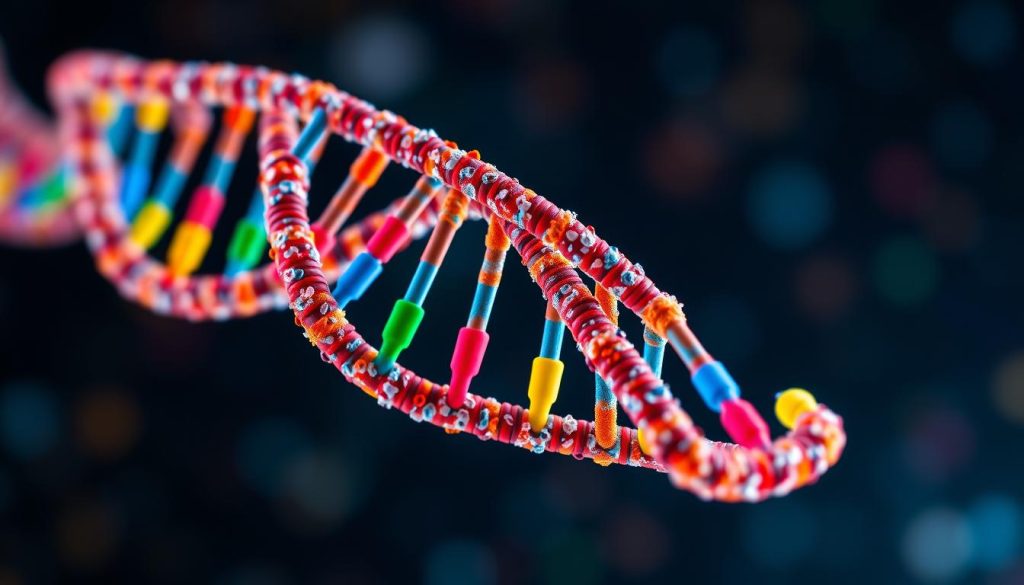
| Base Pair | Hydrogen Bonds | Genetic Information |
|---|---|---|
| Adenine (A) – Thymine (T) | Two | Encode amino acids |
| Guanine (G) – Cytosine (C) | Three | Provide stability to DNA |
Chromosomes and DNA Packaging
In every cell, DNA is packed into structures called chromosomes. These chromosomes are made of DNA and proteins like histones. This helps the DNA fit in the cell’s nucleus. Humans have 46 chromosomes in each cell.
Chromosomes are key for copying and using DNA during cell growth. They help in dividing cells correctly. This is vital for our cells to work right.
The DNA structure was figured out in 1953 by Watson and Crick. They looked at DNA photos by Franklin. DNA is made of nucleotides with sugar, phosphate, and bases A, T, C, and G.
In eukaryotes, like humans, cells have 46 chromosomes. This includes 22 pairs of autosomal chromosomes and a pair of sex chromosomes. Human cells have two sets of chromosomes, making them diploid.
Human gametes, like sperm and eggs, have 23 chromosomes. This makes them haploid. The genome size of E.coli is 4.6 million base pairs.
A human cell has 6 X 10^9 base pairs for all chromosomes. This is like 2.0 meters if stretched out. The nucleus is much smaller than this length.
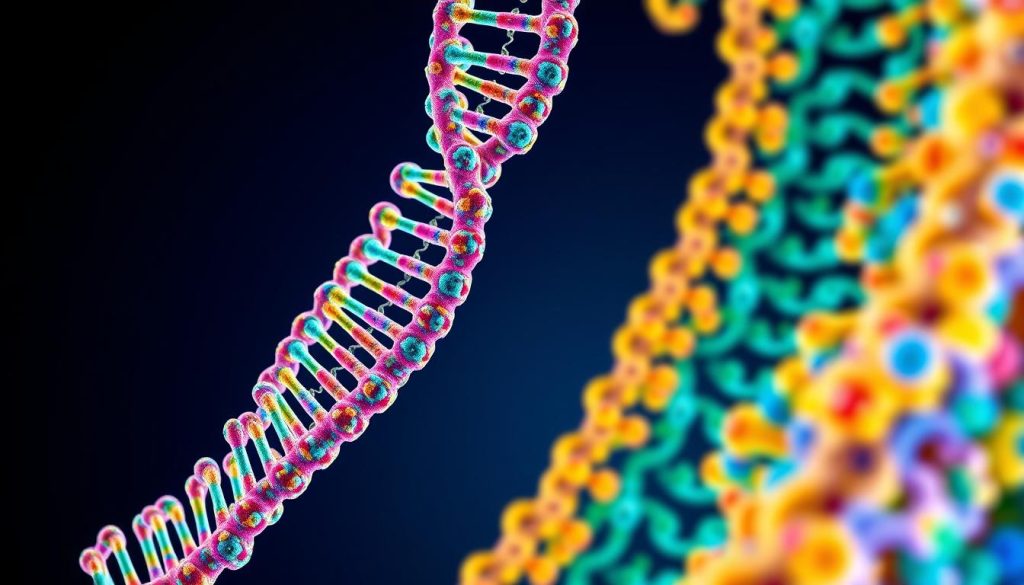
Nucleosomes help pack DNA by wrapping it around histones. There are five main histone types: H1, H2A, H2B, H3, and H4. About one gram of histones is linked to each gram of DNA.
Eukaryotes have histones, but prokaryotes like bacteria don’t. DNA wraps around histone proteins in about 147 base pairs. A nucleosome has two of each histone type and wraps 146 base pairs of DNA.
DNA Replication and Cell Division
DNA replication is key during cell division. It makes sure each new cell gets the same genetic instructions. This starts with the DNA double helix unwinding. Then, new strands are made using the original strands as guides.
This semi-conservative replication means each new cell gets one old and one new DNA strand. This keeps the genetic information safe and sound.
DNA replication is vital for life to keep going. It makes sure genetic information is passed on correctly during cell division. This is crucial for growth, development, and reproduction in all living things.
Many enzymes and proteins work together during replication. They unwind the DNA and help make new strands. This careful process ensures the genetic blueprint is copied accurately.
| Key Steps in DNA Replication | Description |
|---|---|
| Unwinding of the DNA double helix | The DNA helix is unwound by specialized enzymes called helicases, creating a replication fork where DNA synthesis can occur. |
| Synthesis of new complementary strands | DNA polymerase enzymes use the original DNA strands as templates to synthesize new complementary strands, ensuring that each daughter cell receives a complete set of genetic instructions. |
| Maintenance of semi-conservative replication | The process ensures that each daughter cell receives one original and one newly synthesized strand of DNA, preserving the genetic integrity across generations. |
Studying DNA replication helps us understand life’s basics. It also opens doors to new discoveries in medicine, genetics, and biotechnology.
Nucleotides: The Monomers of DNA
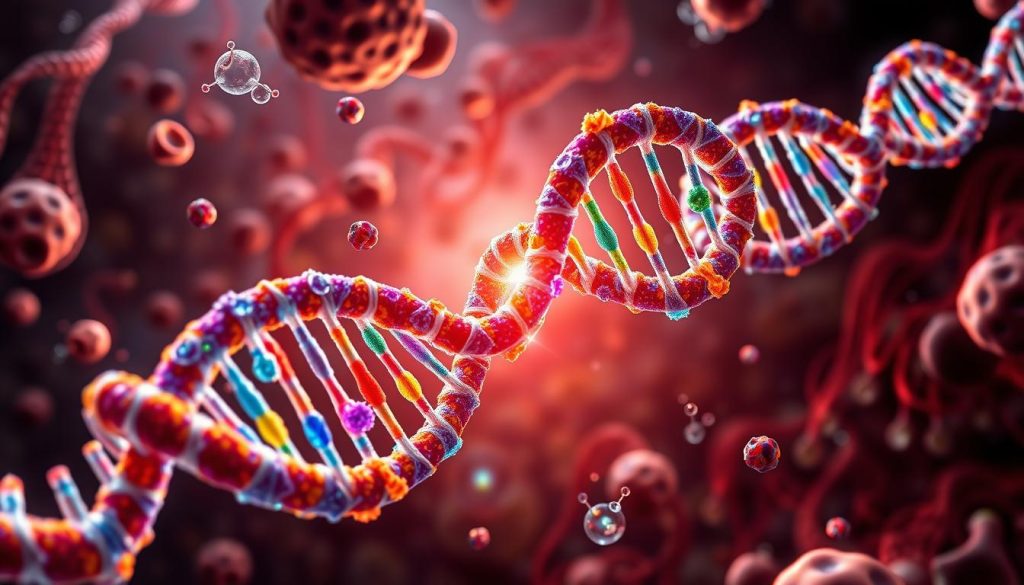
At the heart of DNA, the genetic blueprint of life, lie the fundamental building blocks known as nucleotides. These small, yet crucial molecules are the monomers that form the long, intricate strands of DNA and RNA. They encode the genetic information that directs the synthesis of proteins – the primary functional molecules in living organisms.
The Structure and Function of Nucleotides
Each nucleotide is made up of three main parts: a nitrogenous base (adenine, thymine, guanine, or cytosine in DNA; adenine, uracil, guanine, or cytosine in RNA), a five-carbon sugar molecule (deoxyribose in DNA, ribose in RNA), and a phosphate group. The way these parts fit together in the DNA double helix is key for storing, sending, and using genetic information.
The order of nucleotides in DNA gives the genetic instructions for making proteins. These instructions are read and followed by the cell’s machinery. This ensures the proper growth, function, and upkeep of all living things.
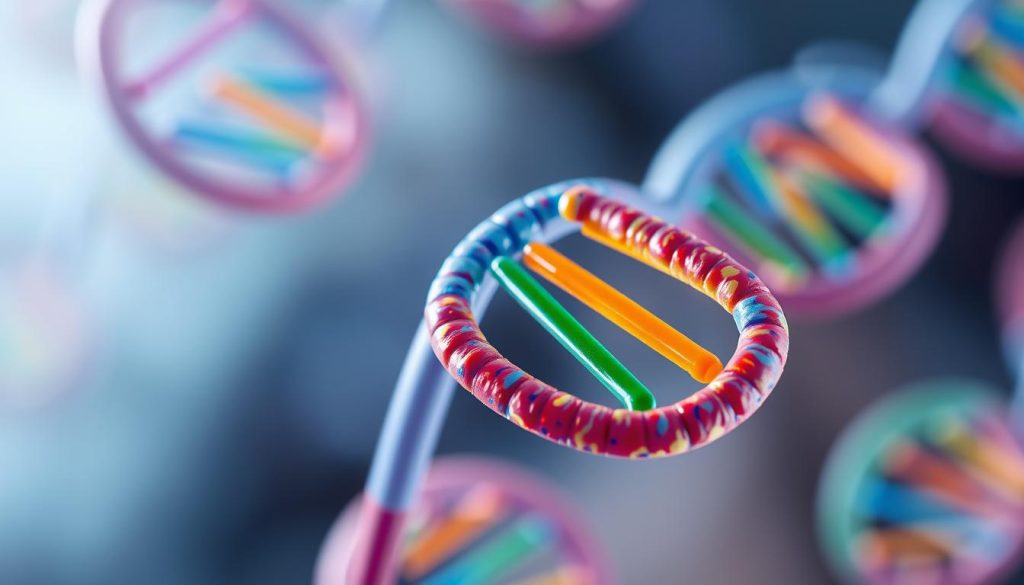
The structure and properties of nucleotides are vital for DNA’s stability and replication, as well as controlling gene expression. Knowing how these building blocks work is key to understanding life. It helps advance fields like genetics, molecular biology, and biotechnology.
The Role of DNA in Heredity
DNA, or deoxyribonucleic acid, is the key genetic material passed from parents to their kids. It ensures life goes on and traits are inherited. When parents have a baby, their DNA mixes, making a new, unique genetic makeup for the child.
The DNA in each cell’s nucleus has all the instructions for an organism’s growth and function. As cells grow and divide, the DNA’s information is copied and shared with new cells. This lets the organism grow and keep its traits. DNA’s role in heredity is a key part of genetics. It helps us understand evolution and the variety of life.
Genetics started with Gregor Mendel in the 19th century. Mendel’s pea plant experiments showed how traits are passed down. Since then, genetics has grown a lot, thanks to scientific research and new tech.
Now, studying DNA is key to understanding life and evolution. It helps us know about physical traits and genetic diseases. DNA research has changed many fields, like medicine and biotechnology.
 Animal behavior: Instincts and learning in nature
As we learn more about the genetic code, DNA’s role in heredity will keep being important. It will help us understand life’s basics and the amazing variety of nature.
Mutations and Genetic Variations
DNA, the blueprint of life, is subject to changes. These changes, called mutations, can happen during DNA replication or due to environmental factors. They can range from having no effect to causing genetic disorders or making us more likely to get certain diseases.
Genetic variations, born from mutations, drive the diversity of life. They bring new traits and characteristics. These can be favored or not during evolution. Knowing how DNA mutations work is key for progress in genetic engineering, personalized medicine, and studying evolution.
Mutations can be small or big changes in DNA. Some might be good, giving new benefits, while others can be bad, causing health issues. These changes help species adapt and survive by allowing them to respond to environmental changes.
Scientists study DNA mutations to understand genetics better, improve treatments, and learn about evolution. By understanding the relationship between mutations and genetic variations, they make discoveries that change biology, medicine, and our view of the world.
| Type of Mutation | Description | Potential Effects |
|---|---|---|
| Point Mutation | A single nucleotide change in the DNA sequence | Can lead to amino acid substitutions, premature stop codons, or no change in the encoded protein |
| Insertion/Deletion | The addition or removal of one or more nucleotides in the DNA sequence | Can cause frameshift mutations, leading to significant changes in the encoded protein |
| Repeat Expansion | An increase in the number of repeating sequences in the DNA | Associated with certain genetic disorders, such as Huntington’s disease and fragile X syndrome |
| Chromosomal Mutations | Large-scale changes in the structure or number of chromosomes | Can result in conditions like Down syndrome, Turner syndrome, and Klinefelter syndrome |
Understanding DNA mutations helps scientists create new treatments, advance genetic engineering, and understand evolution. This knowledge is crucial for our future in biology, medicine, and understanding the natural world.
Biotechnology and DNA Applications
The discovery of DNA’s structure has led to many biotechnological applications. These have changed fields like medicine, agriculture, and more. DNA-based technologies help us manipulate genes and identify genetic markers. This has changed how we treat diseases and improve crops.
These advancements have also changed forensic science and environmental science. As DNA technology grows, we can expect even more changes in our lives and world.
Genetic engineering is a key part of DNA technology. It lets us change genes, making new medicines and crops. DNA sequencing is also vital, used in personalized medicine and environmental studies.
PCR is another important tool. It makes it easy to copy DNA, helping in disease diagnosis and forensic work. This method is crucial for quick identification of diseases and genetic traits.
The future of DNA technology looks bright. It will bring new advances in medicine and agriculture. The possibilities are endless, shaping our future.
| Application | Description | Impact |
|---|---|---|
| Genetic Engineering | Manipulation of genetic material, enabling the insertion, deletion, or modification of specific genes | Revolutionized the production of therapeutic proteins, the development of genetically modified crops, and the creation of novel biofuels |
| DNA Sequencing | Essential tool in various applications, from personalized medicine to environmental monitoring and conservation efforts | Transformed fields such as personalized medicine, environmental monitoring, and conservation efforts |
| PCR (Polymerase Chain Reaction) | Enables the rapid amplification of DNA sequences | Transformed fields such as disease diagnosis, forensic investigations, and the detection of genetic variations |
The Central Dogma of Molecular Biology
The central dogma of molecular biology explains how genetic information flows in living things. It says that DNA information is first copied into messenger RNA (mRNA). Then, this mRNA is turned into proteins, which do the work of the DNA instructions. This flow is key for cells to work right and for genes to be expressed.
Transcription and Translation Processes
Transcription is when mRNA is made from DNA. Translation is when proteins are made from mRNA. In transcription, DNA’s sequence is used to make a complementary mRNA. This mRNA then goes to ribosomes, where it’s translated into amino acids, forming proteins.
- Transcription: The genetic information stored in DNA is copied into a single-stranded mRNA molecule.
- Translation: The mRNA is used as a template to synthesize a specific sequence of amino acids, which then fold into a functional protein.
This central dogma is a key idea in biology. It helps us understand how genes are used and how cells work. By studying these steps, scientists have made big discoveries. These discoveries have helped in genetics, biotechnology, and medicine.
| Process | Description |
|---|---|
| Transcription | The synthesis of mRNA from a DNA template |
| Translation | The synthesis of proteins using the genetic information encoded in mRNA |
DNA Repair Mechanisms
Cells have developed ways to fix DNA errors or damage. These include nucleotide excision repair, base excision repair, mismatch repair, and double-strand break repair. Special enzymes and proteins help find and fix the wrong DNA parts.
These repair systems are key to keeping our genes healthy. They help avoid problems like genetic disorders and cancer. Knowing how they work is vital for cancer research and new treatments.
Recent studies have uncovered how these mechanisms work. For example, EXO1 downregulation in non-small cell lung carcinoma (NSCLC) cancer stem-like cells (CSLCs) induces DNA lesions, triggering apoptosis and enhancing sensitivity to cisplatin. Also, co-downregulation of TLS polymerases Polη and Polι in xenografts significantly reduces tumor proliferation.
Moreover, miR-3163 overexpression sensitizes CSLCs to cisplatin via targeting the EXO1/Polη/Polι axis. This shows how TLS polymerases help fix DNA after cisplatin treatment. miR-3163 inhibits cancer stem cells by modulating the EXO1/Polη/Polι axis through direct targeting of EXO1 and inducing apoptosis.
These discoveries highlight the role of DNA repair in keeping our genes stable. They also point to new ways to fight cancer. By studying these pathways, scientists can create better treatments for patients.
The Future of DNA Research
DNA science is advancing fast, opening up new possibilities. We will learn more about DNA’s structure, function, and uses. This will lead to big steps in personalized medicine, gene therapy, and understanding evolution.
New technologies like DNA sequencing and gene editing will get better. They will help us in healthcare, agriculture, and environmental science. Mixing DNA research with computer science and nanotechnology could bring even more breakthroughs.
 The carbon cycle: How it works and its importance for life
The future of DNA research is full of promise. We will see personalized treatments and genetic engineering advancements. New technologies and deeper understanding will change many areas of life, from health to conservation.
The path ahead is exciting. With hard work and new ideas, DNA research will help solve today’s big challenges. It’s a bright future for unlocking new ways to face humanity’s problems.