

Human-Robot Interaction: Developments in Communication and Collaboration

The field of Human-Robot Interaction (HRI) focuses on the dynamics between humans and robots, aiming to make collaboration as natural and effective as possible. As robots increasingly integrate into various domains—such as healthcare, manufacturing, and personal assistance—the need for seamless and intuitive interaction grows. This article explores advancements in communication and collaboration within HRI, as well as the core concepts, technologies, and challenges shaping the field.
What is Human-Robot Interaction?
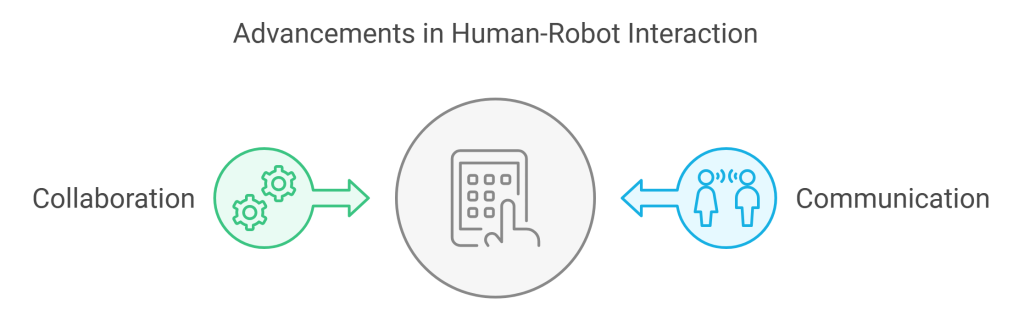
Human-Robot Interaction (HRI) is an interdisciplinary field that studies the mechanisms and processes involved in enabling communication and collaborative tasks between humans and robots. It encompasses aspects from robotics, computer science, psychology, cognitive science, and social sciences. At its core, HRI seeks to bridge the gap between machine and human behaviors, creating interaction models that allow robots to understand human intentions and adapt accordingly.
Key Components of HRI
- Communication: Enabling robots to interpret verbal and non-verbal cues such as speech, gestures, and facial expressions.
- Collaboration: Facilitating task-sharing and teamwork by programming robots to understand and adapt to human actions and decisions.
- Adaptability: Designing systems that allow robots to learn and adjust their responses based on past interactions.
- Safety and Trust: Building systems that ensure safe interaction and foster trust by predicting and responding to human behavior accurately.
Communication in Human-Robot Interaction
Effective communication between humans and robots involves more than simple commands; it requires understanding context, non-verbal cues, and emotional responses. Current developments in Natural Language Processing (NLP) and Computer Vision have played a significant role in enhancing these communication capabilities.
Verbal Communication
Natural Language Processing enables robots to interpret and respond to human language. Key advancements include:
- Speech Recognition: Systems like Automatic Speech Recognition (ASR) and Natural Language Understanding (NLU) are combined to improve accuracy and contextual understanding.
- Sentiment Analysis: Robots use sentiment analysis to gauge emotions from speech, allowing them to respond empathetically in settings like customer service or caregiving.
- Dialogue Management: Robots can engage in multi-turn conversations, handling contextual references and sequential dialogue for more meaningful exchanges.
Non-verbal Communication
Non-verbal cues play a significant role in HRI, as they often convey intent and emotion. Technologies like Computer Vision enable robots to recognize and interpret gestures and facial expressions. Major components include:
- Gesture Recognition: Robots can recognize body movements and interpret gestures using mathematical models such as OpenPose or MediaPipe.
- Facial Expression Analysis: Machine learning models analyze human facial expressions, classifying emotions like happiness, anger, or confusion.
- Eye Tracking and Gaze Detection: By analyzing gaze direction, robots can infer the focus of a human’s attention, useful in tasks that require joint attention.
Collaboration in Human-Robot Interaction
Effective human-robot collaboration (HRC) requires robots to understand complex tasks and cooperate dynamically, adapting to human actions in real-time. This collaboration is especially important in industrial automation, healthcare, and service robotics, where robots and humans often work side by side.
 Robotics in Medicine: Advances in Assisted Surgery and Rehabilitation
 Shared Autonomy and Task Allocation
Shared autonomy involves dividing control between the human and the robot, allowing each to leverage their strengths. Effective task allocation models are crucial to successful collaboration, with methods including:
- Optimization Algorithms: Linear programming and integer programming are used to create optimal task allocation models.
- Reinforcement Learning (RL): Robots use RL algorithms to learn how to best assist humans by maximizing collaborative efficiency over time.
- Dynamic Task Switching: Robots monitor the progress and adapt to changing circumstances, using algorithms such as Markov Decision Processes (MDPs).
Safety and Predictive Modeling
In collaborative environments, safety is a top priority. To prevent accidents, robots use predictive modeling to anticipate human behavior and respond proactively. Key technologies include:
- Proximity Sensors: Detecting human presence to ensure safe distances are maintained.
- Behavior Prediction Models: Using data from past interactions, robots can predict human actions and avoid potential collisions.
- Reactive Control Systems: Robots adjust their actions based on real-time data to ensure safe interactions, often relying on Proportional-Integral-Derivative (PID) controllers for smooth motion adjustments.
Advancements in Human-Robot Interaction Technologies
The rapid development of hardware and software technologies has significantly expanded HRI capabilities. Key technologies include:
Machine Learning and Artificial Intelligence
Machine learning, especially deep learning, has been pivotal in training robots to understand and adapt to complex human behaviors. Models used in HRI include:
- Convolutional Neural Networks (CNNs): Often applied in computer vision tasks like gesture and facial expression recognition.
- Recurrent Neural Networks (RNNs): Used in NLP and dialogue management, enabling robots to process sequences of human speech.
- Transformers: The backbone of advanced NLP models like GPT and BERT, which allow robots to generate and understand complex language constructs.
Sensors and Actuators
High-resolution sensors and actuators allow robots to gather detailed information about their environment, a necessity for precise interaction:
- LIDAR and Camera Sensors: Used for spatial awareness and gesture recognition.
- Haptic Feedback: Allows robots to perceive touch and pressure, creating a more human-like interaction.
- Microphones and Acoustic Sensors: Enable advanced speech recognition and sound localization.
Augmented Reality (AR) in HRI
AR has become a useful tool in HRI, as it helps humans visualize robot intent and actions in real-time, improving coordination and reducing confusion. Robots equipped with AR interfaces can guide users through complex procedures by overlaying digital instructions onto the physical workspace.
 Developing Educational Robots: Promoting STEM Learning from an Early Age
 Challenges in Human-Robot Interaction
While HRI has advanced rapidly, significant challenges remain:
- Interpretation of Human Behavior: Understanding nuanced human intentions and emotions remains difficult, particularly in complex social settings.
- Contextual Understanding: Robots must interpret actions in context, requiring advanced cognitive models that are often challenging to develop and implement.
- Privacy and Ethics: Monitoring human activity for interaction raises concerns about data privacy and ethical usage.
- Reliability in Dynamic Environments: Ensuring that robots function reliably across changing environments is critical, particularly in unstructured settings.
Future Directions of Human-Robot Interaction
The future of HRI lies in enhancing robot adaptability, autonomy, and emotional intelligence. Promising areas of research include:
Personalized Interaction Models
As robots become more integrated into daily life, developing personalized interaction models will allow them to adapt to individual preferences and behavioral patterns. Machine learning algorithms that customize interactions based on past exchanges will make HRI more intuitive and responsive.
Emotional Intelligence in Robots
Advances in affective computing are enabling robots to recognize, interpret, and simulate human emotions. Emotional intelligence will play a key role in applications like healthcare, where empathetic interaction is essential.
Cognitive Architectures for Long-term Autonomy
For robots to work autonomously over extended periods, they will need to develop cognitive architectures that support continuous learning and adaptability. Hierarchical Task Networks (HTNs) and cognitive frameworks that incorporate memory and goal-oriented behavior will be integral to making robots more autonomous in human environments.
Collaborative Learning Environments
Collaborative learning environments, where humans and robots learn from each other, will help improve HRI over time. Shared learning allows robots to refine their models and tasks, making them more effective partners in dynamic settings.
 Kinetic Energy in Action: Key Concepts and Real-World Examples
 Human-Robot Interaction is transforming how humans and robots work together, from understanding complex verbal cues to safely collaborating on intricate tasks. As AI and sensor technologies advance, robots will become increasingly capable partners, capable of navigating complex social landscapes and adapting to human needs.
While challenges remain, ongoing research in communication, cognitive modeling, and adaptability holds the promise of creating robots that are safe, reliable, and genuinely collaborative partners in diverse applications.


