
Tectonic Plates and Earthquakes: Earth’s Geologic Engine

Tectonic Plates and Earthquakes
The Earth is a dynamic and ever-changing planet, shaped by the movement of tectonic plates beneath its surface. These massive sections of the Earth’s lithosphere move, interact, and collide, creating various geological phenomena, including earthquakes, mountain ranges, and volcanic eruptions. Understanding tectonic plates and their role in shaping the planet is crucial to understanding the Earth’s geological engine.
What Are Tectonic Plates?
Tectonic plates are large, rigid pieces of the Earth’s lithosphere that float on the semi-fluid asthenosphere beneath them. They vary in size, ranging from small fragments to enormous plates that cover entire continents and oceans. The Earth’s lithosphere is divided into seven major tectonic plates and several minor ones. These plates are constantly in motion, driven by the heat within the Earth’s core, which creates convection currents in the mantle.
The Types of Plate Boundaries
Tectonic plates interact with each other at plate boundaries, and these interactions are responsible for many geological events. There are three primary types of plate boundaries:
 Why Earth Has an Invisible Magnetic Shield
- Divergent Boundaries: At divergent boundaries, tectonic plates move away from each other. This often occurs along mid-ocean ridges, where new oceanic crust is formed as magma rises from the mantle. The East African Rift is an example of a divergent boundary.
- Convergent Boundaries: At convergent boundaries, tectonic plates move toward each other. When two plates collide, one may be forced beneath the other in a process called subduction, leading to the formation of mountain ranges or volcanic activity. The collision between the Indian Plate and the Eurasian Plate has formed the Himalayas.
- Transform Boundaries: At transform boundaries, tectonic plates slide past each other horizontally. This movement can cause intense seismic activity, such as the San Andreas Fault in California, where the Pacific Plate slides past the North American Plate.
The Connection Between Tectonic Plates and Earthquakes
Earthquakes occur when stress accumulates along faults, fractures in the Earth’s crust, and is released in the form of seismic waves. These seismic events are closely linked to the movement of tectonic plates. At plate boundaries, the interaction between plates can cause the Earth’s crust to deform, creating pressure. When this pressure exceeds the strength of the rocks, it results in an earthquake.
Subduction Zones and Their Role in Earthquakes
Subduction zones, where one tectonic plate is forced beneath another, are particularly prone to powerful earthquakes. As the descending plate moves into the mantle, it causes immense friction and pressure to build up. This tension can be released suddenly, triggering earthquakes. The 2011 Tōhoku earthquake in Japan, a magnitude 9.0 earthquake, occurred along a subduction zone where the Pacific Plate was forced beneath the North American Plate.
Earthquake Magnitude and Measurement
The size of an earthquake is measured using the Richter scale, which assigns a numerical value to the magnitude of seismic waves. For instance, a magnitude 5 earthquake is considered moderate, while a magnitude 9 earthquake is catastrophic. However, the impact of an earthquake also depends on factors such as depth, distance from the epicenter, and the surrounding infrastructure.
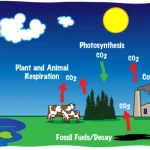 The Carbon Cycle and Its Role in Earth’s Climate
The formula for calculating the magnitude of an earthquake is given by:
M = log10(A) - log10(A0), where M is the magnitude, A is the amplitude of the seismic wave, and A0 is a reference amplitude.
The Role of Tectonic Plates in Earth’s Ongoing Evolution
Tectonic plate movements have shaped the Earth over millions of years. These movements are responsible for the formation of continents, mountain ranges, ocean basins, and the Earth’s internal heat exchange. As tectonic plates continue to shift, the Earth will continue to evolve, creating new geological features while also generating the occasional destructive force, such as earthquakes.
 Unique Ecosystems and Earth’s Biodiversity Hotspots
How Do Tectonic Plates Influence Human Society?
The movement of tectonic plates not only shapes the Earth’s geology but also affects human populations. Earthquakes, often occurring along plate boundaries, can cause significant damage to infrastructure and loss of life. Countries located near plate boundaries, such as Japan, Chile, and New Zealand, have developed advanced earthquake preparedness systems to mitigate these risks. Understanding tectonic plate movement is essential for predicting and preparing for potential seismic hazards.
Conclusion: Earth’s Dynamic Geology
Tectonic plates are the driving force behind many of the planet’s most significant geological events, from the formation of mountain ranges to the occurrence of earthquakes. While tectonic plate movements are slow, their impact on the Earth’s surface is profound, constantly reshaping the planet over time. By studying tectonic plates and understanding their movement, we gain insight into the forces that have shaped, and will continue to shape, the Earth for millions of years to come.


